
Cynanchum viminale (L.) L., Mant. Pl. 2: 392 (1771) (syn: Apocynum viminale Bassi ex Schult. ; Asclepias acida Roxb. ; Asclepias aphylla Roxb. ex Wight ; Cynanchum acidum (Roxb.) Oken ; Decanemopsis aphylla Costantin & Gallaud ; Sarcostemma acidum (Roxb.) Voigt ; Sarcostemma brevistigma Wight & Arn. ; Sarcostemma madagascariense Desc. ; Euphorbia pendula (Haw.) Sweet ; Tithymalus pendulus Haw.);
.
SE. Kenya to NE. Tanzania, W. Indian Ocean, Pakistan to China (S. Guangdong) and Indo-China: Aldabra, Bangladesh, China Southeast, Comoros, Hainan, India, Kenya, Madagascar, Myanmar, Nepal, Pakistan, Réunion, Seychelles, Tanzania, Thailand, Vietnam as per POWO;
.
sigh-NAN-kum or sigh-NANG-kum — Greek: kyon (dog); anchein (to choke or strangle); refers to the historical toxic qualities of several European species within this genus that were observed to poison animals … compiled from the web
vim-in-AH-lee — long, slender shoots … Dave’s Botanary
.
commonly known as: caustic vine, milk rope, sacred soma, soma • Assamese: চন্দ্ৰলতা sondrolota, সোমলতা xomlota • Bengali: সোমলতা soma-lata • Gujarati: ચીરોડી chirodi, સાંઢીયાવેલ sandhiyavel, સોમવલ્લી somvalli • Hindi: सोम soma • Kachchhi: છીરવલ chhirval, કરાડવલ karadval, સાંઢીયાવલ sandhiyaval • Kannada: ಹಂಬುಕಳ್ಳಿ hambukalli, ಕೋಣನಹಂಬು konanahambu, ಸೋಮ soma, ವಸುಕಾಂತಿ vasukaanthi • Kol: कुला तुआर kula tuar • Malayalam: സോമം somam • Marathi: रानशेर ransher, सोमलता somlata • Odia: ବଡ଼ହୁଇ bada hui, ଲଟାସିଜୁ lata siju, ଶ୍ୟାମା shyamaa, ସୋମଲତା somalata • Punjabi: ਸੋਮ som • Rajasthani: खिर खींप khir khimp • Sanskrit: चन्द्रवल्लरी chandravallari, धनुर्लता dhanurlata, द्विजप्रिया dvijapriya, गुल्मवल्ली gulmavalli, इन्दुलेखा indulekha, इन्दुवल्ली induvalli, महागुल्म mahagulma, पद्मकाष्ठ padmakashtha, सोम soma, सोमक्षीरी somakshiri, सोमलता somalata, सोमार्ह somarha, सोमवल्ली somavalli, सुरेष्ट sureshta, यज्ञाङ्ग yajnanga, यज्ञश्रेष्ठ yajnashreshtha, यज्ञवल्ली yajnavalli • Sindhi: ڏُنبَرُ dumbar, ٿوهرِنجلُ thohrinjal • Tamil: கொடிக்கள்ளி kodikkalli, சோமம் somam • Telugu: దుష్టపు తీగ dustappa tiga, ఎరిపులింగ eripulinga, జిగటషుముడు jigatshumoodoo, కొరకల్లి korakalli, కాడు జెముడు kadu jemudu, కొండపాల kondapala, పద్మ కాష్ఠము padmakashtam, పుల్ల జెముడు pulla jemudu, పుల్ల తీగ pulla tige, సోమలత somalata, సోమము somamu, తీగ జెముడు theega jamudu • Tulu: ಸೋಮವಲ್ಲಿ somavalli • Urdu: سوم soma
Names compiled / updated at https://dineshvalke.blogspot.com/2026/09/cynanchum-viminale-l-l.html
.
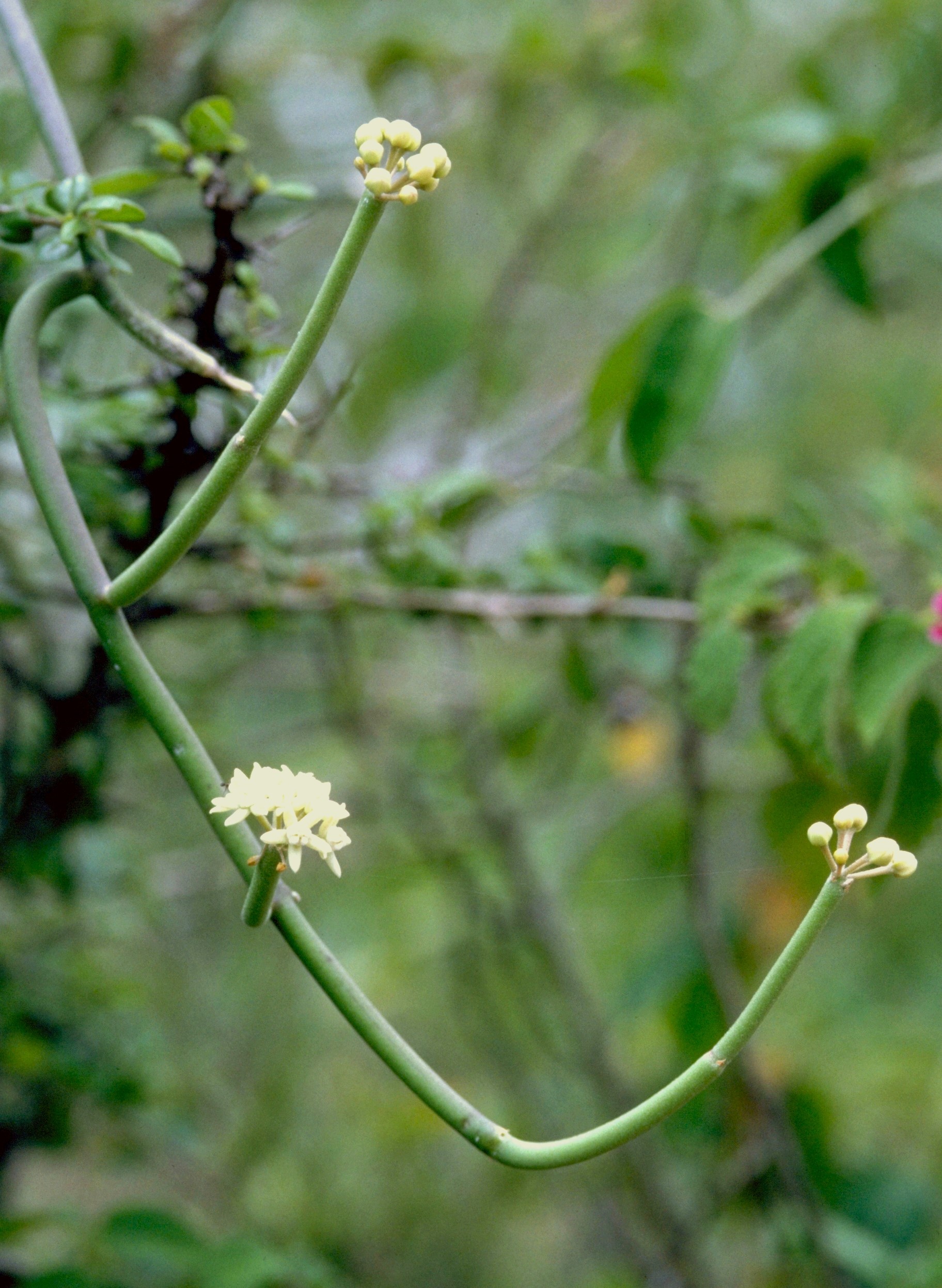
Apocynaceae: Cynanchum viminale subsp. viminale: 1 image.
synonyms: Sarcostemma acidum (Roxb.) Voigt , Sarcostemma brevistigma Wight & Arn., Sarcostemma stocksii Hook.fil.
location/date: Tumkur Distr., Karnataka, July 1997
.
Names of Plants in India :: Cynanchum viminale (L.) L.: 1 image.
Cynanchum viminale (L.) L.
vim-in-AH-lee — long, slender shoots … Dave’s Botanary
.
known for / parts made use of: stems — (cladodes, most widely used part), milky sap — (latex, well-known for its caustic nature), roots — (well-known for counter-toxins), whole plant juice — (the ancient “soma” connection) … compiled from the web
botanical names: Cynanchum viminale (L.) L. … homotypic synonyms: Sarcostemma viminale (L.) R.Br. … accepted infraspecific: Cynanchum viminale subsp. viminale … heterotypic synonyms: Asclepias acida Roxb. • Cynanchum acidum (Roxb.) Oken • Sarcostemma acidum (Roxb.) Voigt • Sarcostemma brevistigma Wight & Arn. … accepted infraspecific: Cynanchum viminale subsp. stipitaceum (Forssk.) Meve & Liede … homotypic synonyms: Sarcostemma stipitaceum (Forssk.) Schult. … and more at POWO, retrieved
August 28, 2026
- Flowers of India … (accessed: August 28, 2026)
- Caustic vine [↗] gets its name from the burning, milky sap inside its green stems. Breaking the stems releases a milky white latex sap that irritates human skin and eyes, and acts as a poison to livestock.
- Milk rope perfectly describes the plant’s long, flexible stems and the thick white sap inside them. Milk — the stems are filled with a toxic, milky latex sap that squirts out when the plant is cut or broken. Rope — the long, leafless, cylindrical green stems intertwine and tangle together, looking exactly like green ropes draped over bushes or rocks. It behaves like a vine, using its rope-like structures to scramble across the ground or climb up nearby trees for support. … compiled from the web.
- Sacred soma — Because the exact botanical identity of the original Vedic Soma plant was lost over thousands of years, it remains one of history’s greatest mysteries. However, Cynanchum viminale became the leading proxy. When the original, elusive Soma plant could no longer be found, ancient priests and Ayurvedic practitioners turned to Cynanchum viminale as its primary ritual and therapeutic substitute. [↗].
- In later Hindu mythology, the deity Soma became closely associated with the Moon. Cynanchum viminale is occasionally called the “Moon plant” or “Moon creeper” because its leafless, luminous grey-green stems were poetically thought to expand and contract in tune with the phases of the moon. [↗].
- for Asclepias acida Roxb. … XOBDO – Your gateway to multilingual knowledge and resources … (accessed: September 01, 2026)
- The Assamese name চন্দ্ৰলতা (Sondrolota) is documented in the XOBDO regional linguistic database for this species. Borrowed directly from classical Sanskrit roots, the compound literally denotes ‘the crescent moon-creeper’. The inclusion proves that communities within the Brahmaputra basin structurally maintained the plant’s ancestral mapping to the lunar taxonomy of the Soma lineages, serving as the primary literary vernacular title for the species in northeastern India. … compiled from the web.
- The Assamese designation সোমলতা (Xomlota) is officially indexed in the XOBDO database for this taxon. While etymologically identical to the standard Devanagari compound Somalata, the regional phonetic profile shifts to a distinct, soft sibilant “Xomlota” native to the Brahmaputra valley. This widespread classical loanword serves as the primary literary title in the state, verifying that the regional flora continues to carry historical ties to ancient Vedic nomenclature. … compiled from the web.
- for Sarcostemma brevistigma Wight & Arn. … PRAIN, DAVID – BENGAL PLANTS – VOL. II
- সোমলতা (Somalata) — Officially documented in Sir David Prain’s foundational botanical compendium, ‘Bengal Plants‘ (1903), under the plant’s historic synonym Sarcostemma brevistigma. This inclusion demonstrates that colonial-era field botanists actively recorded the Sanskrit-derived compound সোমলতা as the recognized vernacular name used by local communities across undivided Bengal. It serves as a vital linguistic record, showing that the plant’s connection to classical Vedic taxonomy was well-preserved in the eastern plains of the subcontinent. … compiled from the web.
- for Sarcostemma brevistigma Wight & Arn. … વનસ્પતીઓ ના ગુજરાતી તથા બોટનીકલ નામ ની યાદી :: સંકલન કર્તા વૈધ શ્રી કે,જે,ઝાલા … (downloaded: 19 Jan 2026)
- Documented by Vaidya Shri K. J. Jhala in his comprehensive compilation of regional botanical nomenclature, Sarcostemma brevistigma (syn. Cynanchum viminale) carries names reflecting both its physical structure and its landscape. The title સાંઢીયાવેલ (Sandhiyavel) translates literally to ‘The Camel Vine’, mapping its jointed stems to the long legs of desert riding-camels. The name ચીરોડી (Chirodi) references its tendency to bleed thick white latex when cut, while the classic loan-word સોમવલ્લી (Somvalli) maintains its formal script relationship to Ayurvedic text history. … compiled from the web.
- for Sarcostemma viminale (L.) R.Br. … Platts, John T. (John Thompson). A dictionary of Urdu, classical Hindi, and English. London: W. H. Allen & Co., 1884.
- Dev, Suresh. (2017). Phytochemical and Pharmacological aspects of Sarcostemma acidum (Roxb.) Voigt. Journal of Pharmacy Research. 11. 1429-1431. … (accessed: August 30, 2026)
- In John T. Platts’ landmark 1884 trilingual dictionary, the word is beautifully tracked across parallel scripts: the Hindi सोम (soma) in Devanagari, and its direct phonological Urdu counterpart سوم (soma) in the Perso-Arabic script. Platts explicitly logs it as a masculine noun borrowed from Sanskrit, identifying it directly with the famous “moon-plant” (Sarcostemma viminale, the classic synonym of Cynanchum viminale).
- for Sarcostemma brevistigma Wight & Arn. … કચ્છ સ્વસ્થાન ની વનસ્પતિઓ ઠાકર જયકૃષ્ણ ઇન્દ્રજી 1926 [PLANTS OF CUTCH AND THEIR UTILITY by THAKAR, JAIKRISHNA INDRAJI, 1926]
- The 1926 botanical treatise Plants of Cutch and Their Utility by Thakar Jaikrishna Indraji documents three distinct Kachchhi dialect names reflecting the plant’s ecological and structural traits. The designation છીરવલ (Chhirval) derives from the Sanskrit root for milk to denote a milk-vine, કરાડવલ (Karadval) translates to cliff-face vine based on its habitat in arid rock fractures, and સાંઢીયાવલ (Sandhiyaval) indicates an association with desert camels. … compiled from the web.
- for Sarcostemma acidum (Roxb.) Voigt … Alar – an authoritative Kannada-English dictionary corpus created by V. Krishna
- ಹಂಬುಕಳ್ಳಿ hambukalli — The name is a literal folk-taxonomic compound. ಹಂಬು (Hambu) means a climbing vine, creeper, or traveler, while ಕಳ್ಳಿ (Kalli) is the generic regional category used for milky-sapped, leafless, or thorny desert succulents (spurges/milkweeds). … compiled from the web.
- The Kannada name ಸೋಮ (Soma) is a direct linguistic adaptation of the ancient Sanskrit word Soma, which carries deep roots in Indian history, philosophy, and botanical taxonomy. In Kannada botanical contexts, it is frequently used interchangeably with extended variations like Somalathe (ಸೋಮಲತೆ) or Somaballi (ಸೋಮಬಳ್ಳಿ), where the suffixes –lathe and –balli explicitly describe its nature as a climbing vine or creeper. … compiled from the web.
- for Sarcostemma viminale (L.) R.Br. … Subrahmanya, Prasad K – Exploration and elucidation of traditional medicinal plants of erstwhile Tulunadu and surrounding area of Kerala and Karnataka :: Chapter 4 :: Shodhganga – a reservoir of Indian theses @ INFLIBNET
- ಕೋಣ (Kona) — This explicitly means a male buffalo in Kannada. ಹಂಬು (hambu) — this is the traditional regional term for a climbing vine or creeper. The fruits (follicles) allude to the horns of male buffalo. … compiled from the web.
- Dev, Suresh. (2017). Phytochemical and Pharmacological aspects of Sarcostemma acidum (Roxb.) Voigt. Journal of Pharmacy Research. 11. 1429-1431. … (accessed: August 30, 2026)
- for Sarcostemma acidum (Roxb.) Voigt … Alar – an authoritative Kannada-English dictionary corpus created by V. Krishna
- An elegant linguistic connection emerges when analyzing the classical name ವಸುಕಾಂತಿ (Vasukaanthi). While ‘Vasu‘ classically denotes solar deities or wealth, ancient lexicons (like the Monier-Williams corpus) also define ‘Vasu‘ as a rope, thong, or rein. ಕಾಂತಿ (Kaanthi): Translates directly to “glow”, “splendour”, “radiance” or “brilliance”. Given that this leafless succulent is globally nicknamed the ‘Milk rope’ due to its cord-like stems, the name వసుకాంతి (Vasukaanthi) beautifully double-serves as a poetic descriptor meaning ‘the radiant rope’ or ‘the beautiful vine’. … compiled from the web.
- for Sarcostemma brevistigma Wight & Arn. … A forest flora of Chota Nagpur including Gangpur and the Santal-Parganahs by Haines, Henry Haselfoot, 1867-1943
- Frequently miscopied as ‘Kula Thar‘ in pharmaceutical texts, tracking the name to H.H. Haines’ ‘A Forest Flora of Chota Nagpur’ (1910) yields the authentic tribal name ‘Kula Tuar‘. By comparative analysis of Haines’ records for other milky-sapped species, ‘Tuar‘ (or Toa) is the literal Munda/Santali word for milk. Paired with ‘Kula‘ (Tiger), the vernacular name for Cynanchum viminale brilliantly translates to ‘Tiger’s Milk’ — a vivid ethno-botanical descriptor for the plant’s thick, remarkably caustic, and toxic white latex. … compiled from the web.
- for Cynanchum acidum (Roxb.) Oken … Gundert, Hermann. A Malayalam and English dictionary. Mangalore, London, C. Stolz; Trübner & Co., 1872.
- Borrowed directly from the classical Sanskrit root, the designation links the plant’s distribution in the southern peninsula to historical botanical lineages. While contemporary coastal databases occasionally use the expanded variant സോമവളളി Somavalli, Gundert’s early text establishes that the concise, traditional title was formally logged over a century ago to identify the species within the regional landscape. … compiled from the web.
- for Sarcostemma viminale (L.) R.Br. … Molesworth, J. T. (James Thomas). A dictionary, Marathi and English. 2d ed., rev. and enl. Bombay: Printed for government at the Bombay Education Society’s press, 1857.
- Dev, Suresh. (2017). Phytochemical and Pharmacological aspects of Sarcostemma acidum (Roxb.) Voigt. Journal of Pharmacy Research. 11. 1429-1431. … (accessed: August 30, 2026)
- The Marathi term “रानशेर” (Ransher) serves as a traditional folk compound for Sarcostemma acidum (synonym Cynanchum viminale), reflecting the plant’s native scrubland habitat and morphological resemblance to leafless milk-hedges. Documentation of such vernacular terminology within regional botanical compilations highlights traditional rural categorization methods that contrast with classical Sanskrit nomenclature. … compiled from the web.
- सोम (Soma) = Moon / Nectar of immortality; लता (Lata) / वेल (Vel) = Creeper / Vine. Literally translates to “Moon Creeper”.
- for Sarcostemma brevistigma Wight & Arn. … K. R. Kirtikar, Basu B. D. Indian Medicinal Plants Vol 3, 1918. … (accessed: August 31, 2026)
- The 1918 reference work Indian Medicinal Plants by Kirtikar and Basu logs three traditional names for the region of Odisha. The standard literary designation ସୋମଲତା (Somalata) aligns with Sanskrit-derived Ayurvedic terminology. Conversely, the term Notasiju represents a colonial typographic distortion of the authentic Odia compound ଲଟାସିଜୁ (Lata Siju), which translates to climbing succulent milkweed. The entry Borohwi serves as an anglicized phonetic rendering of ବଡ଼ହୁଇ (Bada Hui), a regional colloquialism designating a large or extended wild succulent vine. … compiled from the web.
- for Sarcostemma viminale (L.) R.Br. … Praharaj, G.C. Pūrṇṇachandra Orḍiā bhāshākosha: a lexicon of the Oriya language. Cuttack: Utkal Sahitya Press, 1931-1940.
- The entry ଶ୍ୟାମା (Shyamaa) is recorded in Praharaj’s Purnachandra Odia Bhashakosha for this species. While the literal linguistic root denotes a dark or black hue — a trait contradicting the bright green, leafless morphology of Cynanchum viminale — the designation stems from traditional Ayurvedic pharmacopoeia. In historic regional medical practices, this succulent served as an approved therapeutic substitute for the true Black Creeper (Ichnocarpus frutescens), causing the classical title to be fluidly inherited by the substitute species in regional lexicons. … compiled from the web.
- for Sarcostemma viminale (L.) R.Br. … Singh, Maya. The Panjabi dictionary. Lahore: Munshi Gulab Singh & Sons, 1895.
- The 1895 historical lexicon The Panjabi Dictionary by Bhai Maya Singh indexes ਸੋਮ (Som) as a recognized Punjabi designation. Derived directly from the classical Sanskrit root, the term tracks the species’ traditional nomenclature into the fertile plains of the Indus tributaries. This inclusion provides an authentic Gurmukhi script record, demonstrating that regional Punjabi lexicography preserved the ancestral connection between this leafless succulent and the ancient lunar lineages of the Soma traditions. … compiled from the web.
- Manju Chaudhary and S.K. Shringi – Floristic Composition of Beer Jhunjhunu Conservation Reserve of Rajasthan, India – The Biobrio 4(1 & 2), 2017 … (downloaded: Feb 9, 2022)
- The local name “Khir-khimp” derives from a compound of the Sanskrit-derived regional word “Khir“, meaning milky fluid or latex, and “Khimp“, the local designation for leafless desert shrubs possessing a similar appearance. This folk-taxonomic descriptor literally translates to “the milky khimp”, distinguishing this sap-bearing plant from visually identical desert look-alikes that feature clear or watery sap. … compiled from the web.
- for Sarcostemma brevistigma Wight & Arn. … K. R. Kirtikar, Basu B. D. Indian Medicinal Plants Vol 3, 1918. … (accessed: August 31, 2026)
- for Sarcostemma viminale (L.) R.Br. … Learn Sanskrit – पठत संस्कृतम् – शब्दकोशः
- for Asclepias acida Roxb. … Learn Sanskrit – पठत संस्कृतम् – शब्दकोशः
- for Sarcostemma stipitaceum (Forssk.) Schult. … Parmanand Mewaram. A Sindhi-English dictionary. Hyderabad, Sind : The Sind Juvenile Co-operative Society, 1910.
- The 1910 lexicon A Sindhi-English Dictionary by Parmanand Mewaram registers the regional name ڏُنبَرُ (Dumbar) for Sarcostemma stipitaceum. While historically classified as an independent species, modern molecular reclassifications recognize this taxon as Cynanchum viminale subsp. stipitaceum. This inclusion provides an authentic Perso-Arabic script record for the hyper-arid Indus basin, anchoring the plant’s terminology within the historical flora of Sindh. … compiled from the web.
- for Sarcostemma brevistigma Wight & Arn. … K. R. Kirtikar, Basu B. D. Indian Medicinal Plants Vol 3, 1918. … (accessed: August 31, 2026)
- The definitive reference Indian Medicinal Plants by Kirtikar and Basu logs the vernacular name Thorinjal for the Sindh region. Etymological analysis reveals that the term is a compound utilizing the regional desert root Thor, which indicates a leafless, latex-bearing succulent, coupled with a dialect suffix Injal denoting a network or tangled thicket. The designation serves as an accurate folk-taxonomic description of the plant’s bare, interlocking stem architecture in the arid Indus plains. … compiled from the web.
- for Sarcostemma brevistigma Wight & Arn. … University of Madras. Tamil lexicon. [Madras], University of Madras, 1924-1936.
- The foundational Tamil Lexicon published by the University of Madras documents கொடிக்கள்ளி (Kodikkalli) as the traditional vernacular designation for this species. The name is an exact morphological folk compound consisting of கொடி (Kodi), meaning a climbing vine or creeper, and கள்ளி (Kalli), the generic regional classification for leafless, latex-bearing desert succulents. This folk-taxonomic term translates literally to ‘the climbing milk-hedge’ or ‘the creeping succulent’, distinguishing it from upright, shrub-like members of the same family within the dry scrub ecosystems of southern India. … compiled from the web.
- for Sarcostemma viminale (L.) R.Br. … Winslow, Miron. A comprehensive Tamil and English dictionary of high and low Tamil. Madras: P.R. Hunt, 1862.
- The 1862 lexicon A Comprehensive Tamil and English Dictionary by Miron Winslow documents சோமம் (Somam) as a recognized Tamil name for this species. Derived from the classical Sanskrit root, the designation explicitly links the plant’s regional presence to historic botanical lineages. While contemporary wild-flora databases heavily highlight descriptive folk terms like Kodikkalli, Winslow’s early colonial-era dictionary verifies that the concise, traditional title was formally cataloged over a century and a half ago to identify the species in southern India. … compiled from the web.
- for Sarcostemma brevistigma Wight & Arn. … Flora Andhrika – Plant Wealth of Andhra Pradesh, India … (accessed: August 31, 2026)
- for Sarcostemma viminale (L.) R.Br. … Subrahmanya, Prasad K – Exploration and elucidation of traditional medicinal plants of erstwhile Tulunadu and surrounding area of Kerala and Karnataka :: Chapter 4 :: Shodhganga – a reservoir of Indian theses @ INFLIBNET
- ಸೋಮ (Soma) — the sacred, ritualistic plant energy or celestial deity. ವಲ್ಲಿ (Valli) — the Sanskrit word for a creeping vine, climber, or twining plant. … compiled from the web.
- for Sarcostemma viminale (L.) R.Br. … Platts, John T. (John Thompson). A dictionary of Urdu, classical Hindi, and English. London: W. H. Allen & Co., 1884.
- In John T. Platts’ landmark 1884 trilingual dictionary, the word is beautifully tracked across parallel scripts: the Hindi सोम (soma) in Devanagari, and its direct phonological Urdu counterpart سوم (soma) in the Perso-Arabic script. Platts explicitly logs it as a masculine noun borrowed from Sanskrit, identifying it directly with the famous “moon-plant” (Sarcostemma viminale, the classic synonym of Cynanchum viminale).
- Hassler, Michael (1994 – 2026): World Plants. Synonymic Checklist and Distribution of the World Flora. Version 26.08; last update Aug. 2nd, 2026. Last accessed 28/08/2026 (dd/mm/yyyy).
Malayalam and English names are correct.
.
References:
POWO Catalogue of Life