Selaginella vaginata

Selaginella vaginata Spring, Mém. Acad. Roy. Sci. Belgique 24: 87 (1849) (syn: Hypopterygiopsis compta (Hand.-Mazz.) Li Bing Zhang & X.M.Zhou ; Hypopterygiopsis vaginata (Spring) Li Bing Zhang & X.M.Zhou; Hypopterygiopsis xishuiensis (G.Q.Gou & P.S.Wang) Li Bing Zhang & X.M.Zhou ; Lycopodioides compta (Hand.-Mazz.) H.S.Kung ; Lycopodioides vaginata (Spring) Kuntze ; Selaginella compta Hand.-Mazz. ; Selaginella likabalica K.Aran & Himu Roy ; Selaginella schottmuelleri Warb. ; Selaginella smithii O.C.Schmidt ; Selaginella thomsonii Hieron. ; Selaginella xishuiensis G.Q.Gou & P.S.Wang );
.
Indian Subcontinent to China and Indo-China: Assam, Bangladesh, Cambodia, China North-Central, China South-Central, China Southeast, East Himalaya, India, Laos, Myanmar, Nepal, Pakistan, Thailand, Tibet, Vietnam, West Himalaya as per POWO;
.
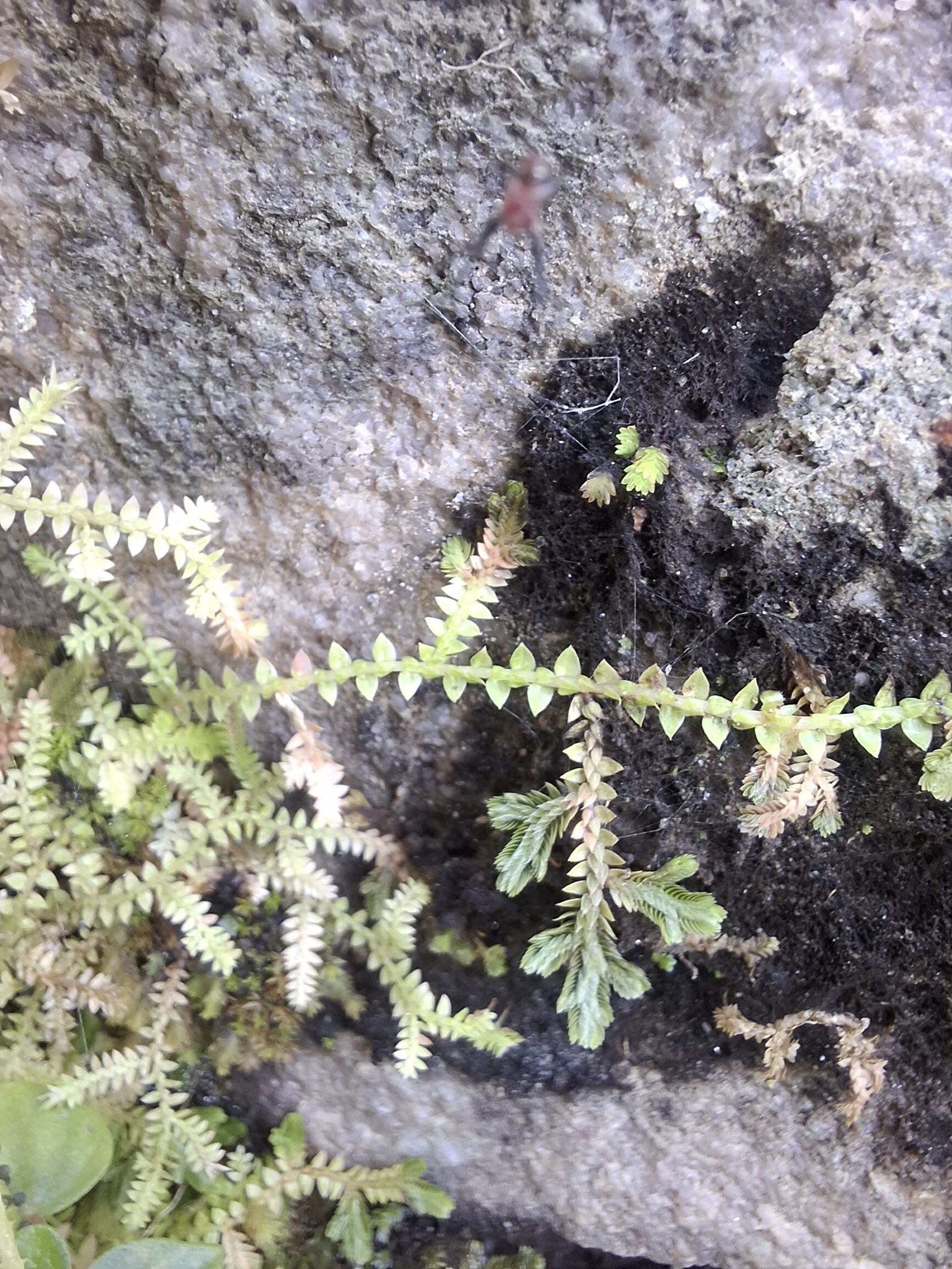


Id:UK00191992: 1 high res. image.
Identify this…

Elevation_ 884m
Location_ Chandi devi haridwar

Habitat _ Macro


About your Selaginella, let me say a few words of advice – as we need photographs to show the diagnostic features – otherwise, not much point in sending or even taking photos.
So first, taking photos with a normal mobile, instead of wih a digital camera (on close-up) – means when I try to magnify them to see small and inportant details, they go out of focus.  This is a problem especially with Selaginella, where I want to see the cilia or teeth on the leaves – and sporophylls..
This specimen has the character of the lateral leaves being strongly symmetrical, not sloping and asymmetrical.  Here they are like equilateral triangles.  In the west Indo-Himalaya that means it could be S. vaginata (common) or S. pallida (uncommon to rare).
But the next thing one always needs to see with Selaginllea specimens or photos is mature fertile branches – to see the strobili.  But this specimen is largely sterile – so that important chracter is not available.  So really I should just label it as “insufficient material”.   There are a few tiny developing fertile tips, but too small to show what mature strobili are like.  You need to show good, mature fertile branches with strobili.
So I wanted to see if the lateral leaves have long cilia towards their bases – but again all goes out of focus……!
In fact I can recognise what it is from its general habit, but the photos and specimen don’t show the necessary features.

It is actually a creeping species that covers open stony road-banks etc., Selaginella vaginata.  The laterals are basally ciliate – you can confirm that yourself using a x 10 hand-lens.


.

References:
POWO  Flora of China  India Flora Online  Bhutan Biodiversity Portal  iNaturalist  Research gate

Updated on October 25, 2026

Related Articles