
Your shopping cart is empty.
Display Prices
Newsletter
Subscribe to our famous monthly newsletter featuring our latest arrivals.
Unsubscribe any time.
Unsubscribe any time.
* E-Mail:
Country:
Wholesale
Wholesale Price List
For those who loved the compact wholesale list from our old website, we have set up a quick and easy reference list with botanical names and wholesale prices.
Google Translate
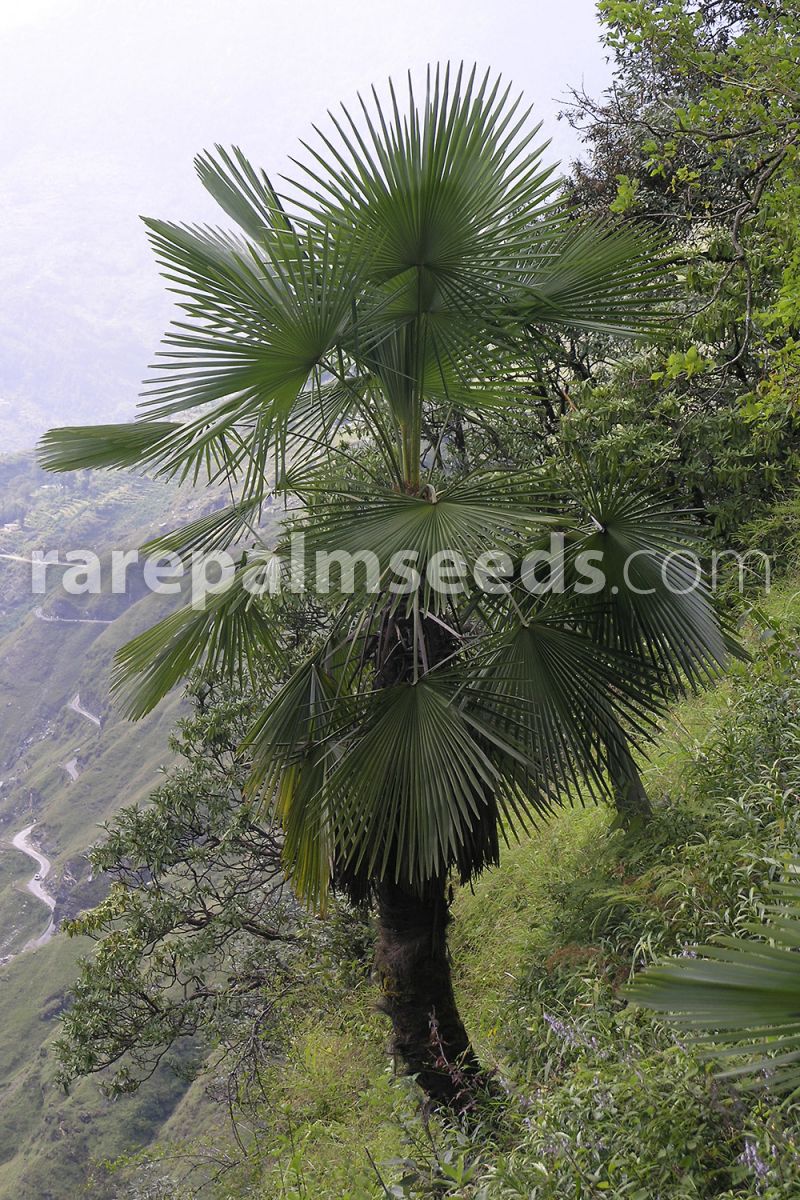
Trachycarpus takil Kumaon Fan Palm
 new
new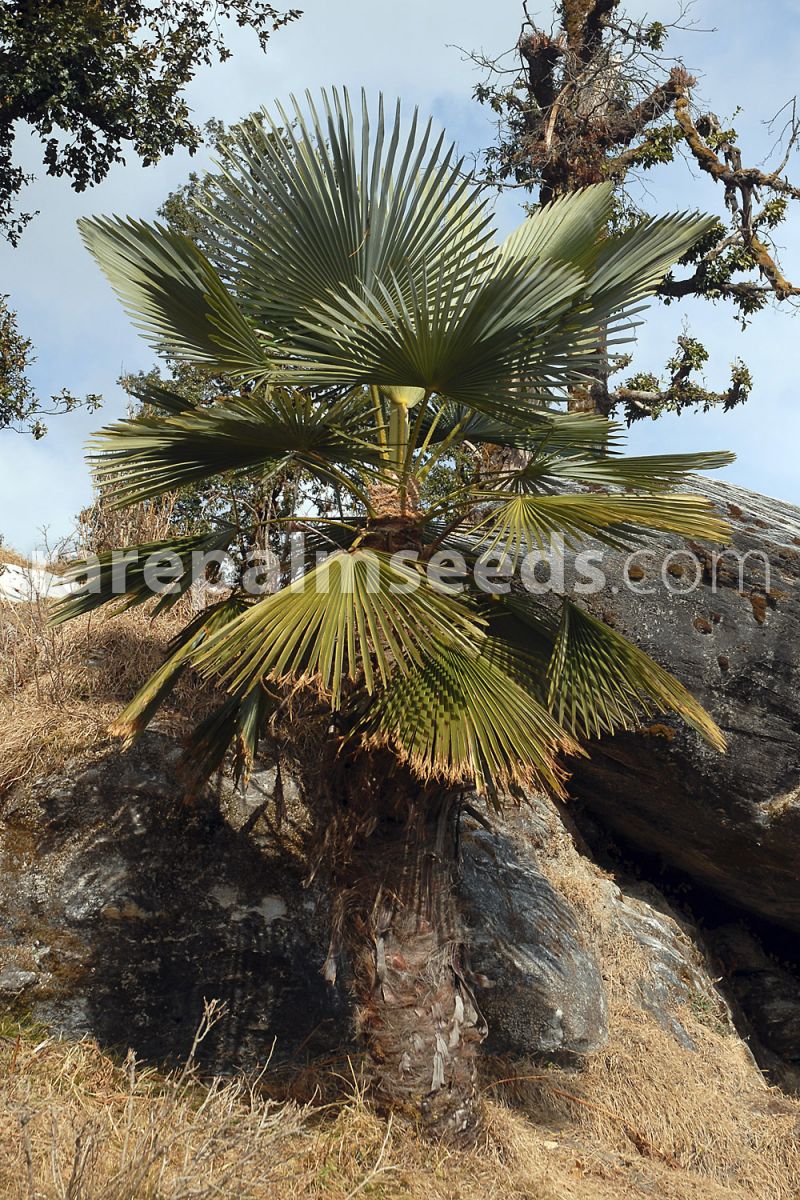


Product Code: Y1-72500
Ornamental Value: Beautiful
Favorites: For Advanced
Availability: Out of stock
Ornamental Value: Beautiful
Favorites: For Advanced
Availability: Out of stock
Some seeds are available for a short time only. Don't miss them! To be notified by e-mail when this species arrives please hit the button above.
Please login/register first.
- Ornamental Value (low–high)
 4.3
4.3 - Germination (difficult–easy)
 2.6
2.6 - Germination Time (years–days) 3.6
- Plant Care (difficult–easy) 2.7
- Speed of Growth (slow–fast) 3.0
- Total 3.2
This species is perhaps the hardiest of all Trachycarpus, coming from cool and moist oak forests in the Himalayas in Kumaon, northern India, to an altitude of over 2400 m (8000 ft.) a.s.l., perhaps reaching as high as 2700 m (8900 ft.), where the winters can be bitterly cold and snow is common. T. takil is most closely related and most similar in appearance to T. oreophilus and when older, has large, palmate leaves with even divisions and whitish undersides. It is most frequently confused with T. fortunei, however, but mature T. takil are generally taller, more vigorous, and larger in all parts. The three best features to tell the two apart are:
- The fibrous leaf bases in the center of the crown of of T. takil have no or only very short, frayed tips while the leaf bases of mature T. fortunei have long, straplike appendages.
- The divisions in a mature mature leaf of T. takil all go to approximately the same depth, while the leaves of T. fortunei are usually very unevenly divided. As a result, the leaf of T. takil has a neater, more clipped and manicured appearance than that of T. fortunei and resembles more the perfect leaf of T. martianus.
- The first true strap leaf after germination, the eophyll, is half as wide in T. takil as it is in T. fortunei, sporting usually only two rather than four folds.
There is probably no other palm that has caused so much controversy as T. takil over its identity and identification since its rediscovery in India in 1991 by Martin Gibbons and Wilko Karmelk. Countless confusions have marked that recent history. The palm was believed nearly extinct in the wild and unfortunately, very few true seeds actually ever made it into cultivation. Nearly all of what has been sold until about 2009 as T. takil came from cultivated sources and is actually a form of T. fortunei, widely grown in northern India since the days of the British rule (you can find this in our archive as Trachycarpus fortunei "Naini Tal"). Since 2009, several reports of sizable stands of T. takil in the hills above Kalamuni documented that the palm fortunately clings to life by more than just a thread and is not so critically endangered as previously thought. This is where seeds are now available from. Trachycarpus takil is undoubtedly one of the hardiest palms, as evidenced by its high altitude habitat. It receives considerable frost and snow there every year. Since the palm is so rare in cultivation, little is known, however, on its precise cold tolerance, but there is good reason to believe it will outperform Trachycarpus fortunei and may be on a par with the dwarf T. nanus and Rhapidophyllum hystrix.
- The fibrous leaf bases in the center of the crown of of T. takil have no or only very short, frayed tips while the leaf bases of mature T. fortunei have long, straplike appendages.
- The divisions in a mature mature leaf of T. takil all go to approximately the same depth, while the leaves of T. fortunei are usually very unevenly divided. As a result, the leaf of T. takil has a neater, more clipped and manicured appearance than that of T. fortunei and resembles more the perfect leaf of T. martianus.
- The first true strap leaf after germination, the eophyll, is half as wide in T. takil as it is in T. fortunei, sporting usually only two rather than four folds.
There is probably no other palm that has caused so much controversy as T. takil over its identity and identification since its rediscovery in India in 1991 by Martin Gibbons and Wilko Karmelk. Countless confusions have marked that recent history. The palm was believed nearly extinct in the wild and unfortunately, very few true seeds actually ever made it into cultivation. Nearly all of what has been sold until about 2009 as T. takil came from cultivated sources and is actually a form of T. fortunei, widely grown in northern India since the days of the British rule (you can find this in our archive as Trachycarpus fortunei "Naini Tal"). Since 2009, several reports of sizable stands of T. takil in the hills above Kalamuni documented that the palm fortunately clings to life by more than just a thread and is not so critically endangered as previously thought. This is where seeds are now available from. Trachycarpus takil is undoubtedly one of the hardiest palms, as evidenced by its high altitude habitat. It receives considerable frost and snow there every year. Since the palm is so rare in cultivation, little is known, however, on its precise cold tolerance, but there is good reason to believe it will outperform Trachycarpus fortunei and may be on a par with the dwarf T. nanus and Rhapidophyllum hystrix.
| Cultural Requirements | |
| Sun Exposure | Full sun from early age Light shade when young Light shade in dry, hot climates |
| Frost Tolerance | Excessive |
| Water Requirements | High |
| Wind Tolerance | Moderate |
| Appearance | |
| Growth Rate | Moderate |
| Growth Form | Small Tree Palmlike Tree |
| Ornamental Value | Beautiful |
| Uses | |
| Properties | Dioecious Evergreen |
| Hazards | Child and Pet Friendly |
| Gardening | Avenue Landscaping Ornamental Potted |
| Classification | |
| Plant Group | Palms |
| Botanical Order | Arecales |
Sort by:
Write a comment Please log in first.
Share your knowledge! Write a comment and enter to win EUR 50. Read more...
Your NameYour Comment No HTML please.
Rating
| Overall Rating (low–high) | |
| Ornamental Value (low–high) | |
| Germination (difficult–easy) | |
| Germination Time (years–days) | |
| Plant Care (difficult–easy) | |
| Speed of Growth (slow–fast) |
| Pros (optional, max. 3) | Cons (optional, max. 3) |
Similar Species
From EUR 6.60
Out of stock
Out of stock
We described this rare palm as a new species (see PRINCIPES Vol. 41, No. 4. 1997) from a single mountain range in northern Thailand, where it grows on...
Customers who bought this item also bought


Customers who viewed this item also viewed



Spam
Inappropriate language
Wrong species
Wrong language
General
Other (please write below)
Inappropriate language
Wrong species
Wrong language
General
Other (please write below)
Copyright 1997 - 2020 © rarepalmseeds.com