
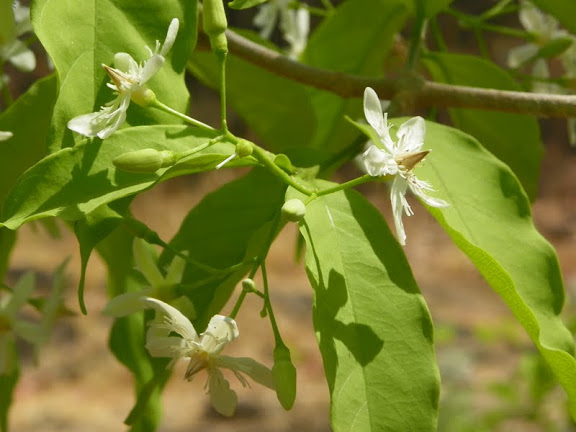
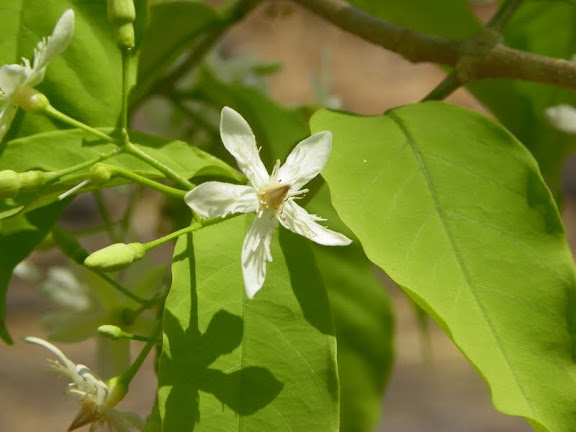
Wrightia tinctoria R.Br., Asclepiadeae 59 1810. (Syn: Allamanda verticillata Desf.; Alstonia oleandrifolia Lodd. ex Loudon; Nerium jaspideum Span. [Invalid]; Nerium tinctorium Sweet [Illegitimate]; Nerium tinctorium Roxb.; Wrightia laciniata A.DC.; Wrightia timorensis Miq.); . RITE-ee-a — named for William Wright, Scottish physician and botanist … Dave’s Botanary tink-TOR-ee-uh — used in dyeing or has a sap which can stain … Dave’s Botanary . commonly known as: dyer’s oleander, ivory wood tree, pala indigo plant, sweet indrajao • Angika: दूधखरी dudhkhree, दूधकोरिया dudhkoria, दूधलरिया dudhlaria • Bhili: केर्नी kerni • Bhojpuri: दूधखरी dudhkhree, दूधकोरिया dudhkoria, दूधलरिया dudhlaria • Dogri: दुद्द रुक्ख dudd rukkh, मिट्ठा इंद्रजौ mittha indrajau • Gondi: करू karu • Gujarati: દુધલો dudhalo, ઈંદ્રજવ મીઠો indrajav meetho, કૂડી kudi, મીઠો દૂધલો mitho dudhalo, રૂંછાળો દૂધલો runchalo dudhlo • Haryanvi: दूधी dudhi • Hindi: दूधी dudhi, कपार kapar, करायजा karaeja, मीठा इन्द्रजौ mitha indrajau • Kachchhi: દૂધિયો dudhio, જંગલી ઝાડ jangli zad • Kannada: ಅಲಿಗಿಲಿ aligili, ಬೆಪ್ಪಾಲೆ beppaale, ಹಲ್ಲುನೋವು ಮರ hallunovu mara, ಕರೆ ಕೊಡಸಿಗೆ kare kodasige, ಕಿರಿ ಕೊಡಸಿಗೆ kiri kodasige, ಕೋಡಮುರಕ kodamuraka • Konkani: काळो कुडो kalo kudo • Magadhi: दूधखरी dudhkhree, दूधकोरिया dudhkoria, दूधलरिया dudhlaria • Malayalam: അയ്യപ്പാല aiyappaala, ദന്തപ്പാല dhanthappaala, ഗൊപ്പമ്പാല goppampaala, ഇരുമ്പാല irampaala, കമ്പിപ്പാല kambippaala, തൊണ്ടപ്പാല thondappaala, വെൽപ്പാല velppaala • Marathi: भूरेवडी bhurevadi, गोडा इंद्रजव goda indrajav, काळा कुडा kala kuda • Odia: ଧଳା କୁରେଇ dhala kurei, ଦୁଧ କେରୁଆଁ duda keruain, ଦୁଧୋକ୍ରିୟା dudhokriya, କ୍ରିୟୋ kryo, ପିତା କରୁଆଁ pita karuan, ଶ୍ୱେତକୁଟଜ swetakutaja • Rajasthani: भाकर आक bhakar aak, दूधी dudhi, खिरनी khirni • Sanskrit: असित कुटज asita kutaja, हयमारक hayamaraka, श्वेत कुटज shweta kutaja • Tamil: இரும்பாலை irumpalai, பாலைநீலம் palainilam, வெட்பாலை vetpalai • Telugu: అంకుడు ankudu, దొడ్డ పాల చెట్టు dodda paala chettu, కొడిశ విత్తులు kodisha-vittulu, కోలముఖి kolamukhi, పాల కొడిశ paala kodisha, పాల వేరి paala veri, రెప్పాల చెట్టు reppala chettu, తెడ్ల పాల tedla paala • Tulu: ಎಂಜಿರುಪ್ಪಾಲೆ enjiruppale, ಕೂಲಿಬೇನೆತ ತಪ್ಪು koolibenetha thappu, ನಯಿಕೂರಿ nayikuli • Urdu: کرايجا karaeja Names compiled / updated at https://dineshvalke.blogspot.com/2026/11/wrightia-tinctoria-roxb-rbr.html . The leaves are applied as a poultice for mumps and herpes and sometimes, they are also munched to relieve toothache. In folk medicine, the dried and powdered roots of Wrightia along with Phyllanthus amarus (keezhanelli) and Vitex negundo (nochi) is mixed with milk and orally administered to women for improving fertility. The bark and seeds are effective against psoriasis and non-specific dermatitis. It has anti-inflammatory and anti-dandruff properties and hence is used in hair oil preparations; . The wood is the most sought after part, as it is used in all types of turnery. The wood is used in famous ‘Channapatna toys’; . Small deciduous tree. Leaves opposite 7-10 cm, elliptic. Flowers in lax cymes 3-4cm diameter. . Milky sap oosed on cutting a twig. . In Holarrhena antidysenterica, the follicles (fruits) are connected at the tip whereas, in Wrightia tinctoria mostly they are distinct/separate rarely they are connected. .
– here attaching mine. This plant is locally used for curing tooth ache. My dad had used this, as prescribed by a local healer and found to be effective.. I heard this plant is also useful for treating Psoriasis and other skin problems
Request Species Id – DKV 19042011-1: Tree seen in the forests near Mhow, Dist Indore, Madhya Pradesh during a night trek with the Youth Hostels Association of India, Indore District Unit. The local guide used a name like “Dudhia” which seemed so apt. – It looks like Wrightia. Close up of flower may help. … posted beautiful picture of this plant few days back. – Wrightia tinctoria. This is a common tree in Chennai and Mysore. I have photographed this tree recently near my house (a road side tree).
29042011PJ1 ID request: Pl find attached photo for id Date/Time-: 29/04/11 – 08:45 – This is Kala Kuda {Wrightia tinctoria]. – this is Wrightia tinctoria – its very much confusion in kala kuda and pandhra kuda the local marathi name.. – Just for comparison. Wrightia bark. http://www.youtube.com/watch?v=Y2U4-9HiPgk – My information (Useful Plants of India, CSIR) is reverse, as rightly written by .. and .. Kala Kuda, Indrajau, mitha indrajau refer to Wrightia tinctoria – Agreed there is a bit of confusion in the local [Marathi / Hindi] names. . 140412 BRS 350 for id. request.: This is Kala Kuda [Wrightia tinctoria].
Trees of Lalbagh, Bangalore – Wrightia tinctoria – Sweet Indrajao Tree: The leaves are applied as a poultice for mumps and herpes and sometimes, they are also munched to relieve toothache. In folk medicine, the dried and powdered roots of Wrightia along with Phyllanthus amarus (keezhanelli) and Vitex negundo (nochi) is mixed with milk and orally administered to women for improving fertility. The bark and seeds are effective against psoriasis and non-specific dermatitis. It has anti-inflammatory and anti-dandruff properties and hence is used in hair oil preparations. The wood is the most sought after part, as it is used in all types of turnery. The wood is used in famous ‘Channapatna toys’.
images of Wrightia tinctoria from Sathy.: Sharing the images of Wrightia tinctoria from Sathy, Erode District. Date: 26.12.2011 Location: Sathy Road, Erdoe Dist. Habitat: Rurual, Road side. Habit: Tree
Wrightia tinctoria (Flower & Fruit): Photographed on Friday, 3rd Feb., at Matheran.
14022012 BS-1 Small Tree for id from Maihar MP: (14 pictures) Pls id this Small Tree from Maihar MP Growing Wildly/ Small tree or shrub about 6-8 feet high/ Leaves simple and opposite about 12-15 cm in length No flowers were seen. Fruit about 3-40 cm long cylindrical I think Wrightia tinctoria of Apocynaceae family. For me also Wrightia tinctoria What about Holarrhena antidysenterica? just a speculation, as the plant has dried up… may be Wrightia… as both are very close.. In Holarrhena antidysenterica, the follicles (fruits) are connected at the tip whereas, in Wrightia tinctoria mostly they are distinct/separate rarely they are connected. Leaves are also different. Here the leaves seen in the last 2 pictures are of Wrightia. Yes, you are right … Thanks for clarifications…..
Small tree at Sandhan Valley : Requesting ID of a small tree seen at Sandhan valley, near Sangamner, Maharashtra. Wrightia tinctoria पांढरा कुडा Yes it is Thank you …! Little confusion about the local names.. when I searched on Flowers of India, the local name for Wrightia tinchtoria is given as Kala Kuda (काळा कुडा) and Holarrhea pubescens is named as Pandhra Kuda (पांढरा कुडा). ????? Affirmative. This is Wrightia tinctoria. Please check these links to add further to your confusion : Just spoke to Dr. Almeida. Contrary to what I previously believed…. Wrightia tinctoria is Safed Kuda because the leaves after they dry turn white, whereas in Holarrhena pubescens they become dark.
Sweet Indrajao : Attachments (2). 1 post by 1 author. I love Apocynaceae family Members 😀 😀 Sweet Indrajao Botanical name: Wrightia tinctoria Family: Apocynaceae (oleander family) May 15/2013 Mumbai
Wrightia tinctoria :: BR Hills Karnataka : Attachments (3). 4 posts by 4 authors. Wrightia tinctoria Apocynaceae. Small deciduous tree. Observed on way to BR Hills Karnataka. May 2013. Leaves opposite 7-10 cm, elliptic. Flowers in lax cymes 3-4cm diameter. Milky sap oosed on cutting a twig. Corona nicely observed. Nice pictures. The tree is very common in Mysore city, often planted in avenues and parks. The timber is used for making toys (Channapatna toys).
Yeoor hills visit report May 15/2013 (mixed thread): 1 correct image as above. Attachments (1). 3 posts by 2 authors. Visited yeoor hills Part of Sanjay gandhi national park, Mumbai, Maharashtra on May 15/2013 Sweet Indrajao
Wrightia tinctoria : ‘Indigo’ foliage : 7 posts by 5 authors. Attachments (1). The withered leaves of Wrightia tinctoria bearing a unique cerulean hue, indicative of the blue dye – Pala Indigo – being yielded from the leaves. Clicked yesterday in Borivali National Park, North Mumbai. Excellent observation & documentation. So nice to see this!! Tho’ there are quite a few W.tinctoria trees in Lalbagh, this has escaped observation!! TFS…. Thanks for posting this. Thank you …, for your comments. Am yet to see the blue leaf impressions on paper / fabric, thanks … am eager to try it out soon. Found in Bangalore 2nd May Yes, Wrightia tinctoria Yes Very good pictures
ARJUL68 Tree for ID : 4 posts by 2 authors. Attachments (3). Nice photographs. Could be Wrightia tinctoria. Pods are usually united at the tip, I think. Could this be Holarrhena pubescens. Bit confused. Yes this tree does look like Wrightia tinctoria.
Tree For ID : Bangalore : 04DEC14 : AK-12 : 3 posts by 2 authors. Attachments (3) Tree seen by the roadside on 9/11/14. No flowers or fruits when the pictures were taken. Wrightia tinctoria Thanks for the id. Have seen Wrightia tinctoria before, couldn’t guess without the flowers.
Wrightia tinctoria – 201214 – RK – 5 : 2 posts by 2 authors. Attachments (2). Pala Indigo – Lalbagh, Bangalore. I find the pods interesting! Meeting at the ends – wonder what purpose it could serve ? Resembles to Wrightia tinctoria
Family: Apocynaceae very nice the petals we see in bengal tend to be a bit wider than what they seem here do you have the entire bush or if mature …. then the tree No I dont ma’am, we were in a very congested spot, could not back up far enough to get a habit shot. It was a tree though.
Wrightia tinctoria : For Validation : Borgad Conservation Reserve : Nasik : 04AUG15 : AK-7 : 07/07 : 5 posts by 3 authors. Attachments (2) Seen at Borgad Conservation Reserve, in July. Kindly validate. Affirmative. Please check the archives of this group for my photographs of this.
TSPDEC2015-17-190: Images of Wrightia tinctoria (Apocynaceae) : 1 post by 1 author. Attachments (5) It is my pleasure to share few images of Wrightia tinctoria (Apocynaceae) Habit: Tree Habitat: Dry deciduous forest Sighting: Tumkur, Karnataka, about 800 msl. Date: 18-05-2014, 16-07-2014, 21-07-2014 and 19-04-2015
TSP-JUN2016-05-393:Images of Wrightia tinctoria (Apocynaceae) : 1 post by 1 author. Attachments (4) It is my pleasure to present few images of Wrightia tinctoria (Apocynaceae) Habit: A medium sized tree. Habitat: Wild, Dry deciduous tree. Sighting: Huliyurdurga, Tumkur, Karnataka, about 800 msl Date: 17-04-2016
Tree for ID 05/07/17 from Yawal, Jalgaon, Maharashtra : 3 posts by 2 authors. Attachments (1) I think Wrightia species. Seems like Wrightia tinctoria
Found inside a Dry decidious forest near Chennai. Big tree. Wrightia tinctoria
Wrightia tinctoria :: Dattaji Salvi Udyan :: 08 APR 18 : 2 posts by 2 authors. 1 image. Dattaji Salvi Udyan Thane Date: April 8, 2018 … Altitude: about 11 m (36 feet) asl Wrightia tinctoria R.Br. . Please check this link for my latest article in ‘Star of Mysore’ : Very well written article on Wrightia tinctoria. Thanks, …, for sharing.
Dried leaves of Wrightia tinctoria – indiantreepix | Google Groups Apocynaceae (Dogbane family)-Wrightia tinctoria from Delhi – efloraofindia | Google Groups Wrightia tinctoria – efloraofindia | Google Groups Tree for ID: 080910BM1 – efloraofindia | Google Groups For ID 070910 ET – efloraofindia | Google Groups Request for ID- 300610RA2 – efloraofindia | Google Groups is this Wrightia tinctoria ? Request for ID-190610SC1 – efloraofindia | Google Groups
Tree seen inside the Zarwani Forest Area in Nov. To me it seems to be Wrightia tinctoria. Experts, kindly validate yes. indrajav of herbal use. no flowers? No flowers, only pods. I wd think the same !
Holarrhena pubescens :: Nagla block of SGNP :: 21 DEC 19 : 6 posts by 3 authors. 2 images. Nagla forest … part of Sanjay Gandhi National Park Date: December 21, 2019 … Altitude: sea level to about 600 ft asl Holarrhena pubescens Wall. ex G.Don Does not it look a bit different from images at Holarrhena pubescens Thanks … At Holarrhena pubescens, at this time of writing, has all pictures showing leaves in their green time. Posted pictures are showing colours during its fall time. I am confident about the ID. I am hoping someone validates my ID to assure of no ambiguity. Could it be Wrightia tinctoria? Thanks very much … for pointing to the correct ID. Many thanks … for arresting the error. Correcting my notes at flickr.
Wrightia tinctoria: The attach plant is Wrightia tinctoria of Apocynaceae, recorded from my home town Warud from Maharashtra. what a nice illustration… of sweet indrajav *Wrightia tinctoria * that you just presented…, Wrightia tinctoria is a glabrous plant. This should be either W. arborea or W. pubescens. Not W.tinctoria. May be other species of Wrightia. Please check the characteristic fruits, which are long and joined at the end even when the fruit dehisces. Leaves are quite different in W.t. The fruit about which … is saying is visible in this film. As per FoC, W. arborea has corona shorter than anthers. So this plant (corona longer than anthers) may qualify to W. pubescens. /wp-content/uploads/attachments/tpod-1-6.html & Flickr Thanks …, for the response. The following links provide keys to different species of Wrightia: http://www.efloras.org/florataxon.aspx?flora_id=2&taxon_id=134988 (Fl.China) http://www.efloras.org/florataxon.aspx?flora_id=5&taxon_id=134988 (Fl.Pakistan) Yes it is W.arborea its a Wrightia arborea Please see my post for W. arborea. Please refer to … observations above (corona longer than anthers) and the leaves are also pubescent but this characteristic is not well seen in these images. Even though the leaves in the posted pictures are resembling that of Wrightia pubescens, the corollary corona as well as the petals are somewhat (rather clearly) differ from the ones in the following links. And I don’t think it can be a variation: Firstly …, I stand corrected on Wrightia pubescens distribution. Please apply FoC keys and let us know the possible answer(s).   Woody shrub for Id 10072013CS1 : Attachments (2). 6 posts by 4 authors. This plant was being used in panchpatra kashayam in a village. From my gleanings it loks like Wrightia sp possibly W. antidysentrica. Can some body identify this woody shrub. By looking at the spent fruits seen in the picture, I guess this to be of Wrightia pubescens. More details may be helpful. wow where could you see the spent fruits. I did confuse between the two species. Both are hosts to the leaf webber observed in abundance on the plants. The damaged leaves turned a bluish grey. The plants are all in this stage and I could not get any more details. I may visit teh village again so hopefully get flowers etc. Thank you for the ID Brilliant …! It is now called Wrightia arborea [Tambda kuda]. My photographs of this are available at these links : I opted the name W. pubescens because Flora of China treats this and W. arborea separately. The latter species is characterized by the fruits with prominent lenticells (white dots on the surface!) which are obvious in the pictures of (fresh) fruits posted by you. I could not see such lenticells from the pictures posted by … here. But, I think you are correct by calling the posted plant as W. arborea due to the probable size of the fruits, which are seemingly narrower in W. pubescens. …, the dried and dehisced fruits (of the previous year) are seen just above the fingers in the 2nd picture. sorry to say that it doesn’t look like Wrightia arborea to me……The leaf shape and numbers of lateral nerves are not typical. In the W. arborea I know there are usually 10 – 12 lateral nerves and the leaves are broader in the middle.
Re : Woody shrub for Id 10072013CS1: : You could be right, but don’t think you can go by the number of lateral veins. Also the fruit look much broader than those of W.tinctoria. Please check the photographs and these links : Will send photographs of the fruit of W. tinctoria later if required. Could manage to find only these photographs (3) of the pods of Wrightia tinctoria now. thanks for your nice photos. This is quite interesting. Found a few more photographs and another link : efi thread Though I am enjoying the scintillating discussion on this species, it has made me more confused. The one thing I can do to help is wait to go back again and post more photos of flowers and pods Yes its Wrightia tinctoria You’re right . (14/Apr/2021 ART 2) Is this Wrightia tinctoria?: 10 images. Date: 2021/Apr/6 Location: Palani, Dindigul District, Tamil Nadu Can you please confirm if this tree is Wrightia tinctoria? Obsolutely correct   Glad to share a couple of pictures of Wrightia tinctoria in full bloom. (“A slender, inconspicuous tree that becomes very beautiful when it flowers at the hottest time of the year.” — Trees of Delhi, Pradip Krishen) Date: 2021/May/8 . Is this Wrightia tinctoria_Tree_ Hyderabad: 4 images. Is this Wrightia tinctoria? Tree location- Velamala, Hyderabad Tree Habit- Wild Height- appx 20 feet Leaves were tomentose Pods were observed on tree. Observed on 24th July 2021. Kindly help in identification. Absolutely you’re right ma’am Yes. Very luxuriant growth. Very common here. It is on my street about 100 ft from my house. The wood is very valuable and used for making world famous Channapatna toys. It has many other medicinal uses. . Wrightia tinctoria (Roxb.) R.Br. :: Virar, Thane :: Apr 1, 2007 · JUN23 DV490: 3 images. Wrightia tinctoria (Roxb.) R.Br. Virar, Thane :: Apr 1, 2007 · 5:29 PM IST :: about 54 m (177 ft) asl Many thanks to Siddarth Machado and Bharat Godambe for validating the ID at iNaturalist . Apocynaceae: Wrightia tinctoria R.Br.: 1 image. location/date: Semadoh, Melghat Wildlife Sancuary, Amravati Distr., Maharashtra, November 1994 . Apocynaceae: Wrightia tinctoria: 4 high res. images. Wrightia tinctoria with blooming at Andhra university campus, Visakhapatnam, Andhra Pradesh. On 20/04/2024 . Respected sir Here with I am attaching the photographs for identification, collected from Ganjam Odisha: 4 high res. images. Closest I can go is https://efloraofindia.com/efi/wrightia-tinctoria/ . Wrightia tinctoria (Roxb.) R.Br. :: Kalsubai Harishchandragad WLS :: Apr 6, 2026 · 4:59 PM IST: 4 images. Wrightia tinctoria (Roxb.) R.Br. Kalsubai Harishchandragad WLS :: Apr 6, 2026 · 4:59 PM IST Kothale, Akole, Ahilyanagar, average altitude 600 m asl . Wrightia tinctoria: 1 image. Family: Apocynaceae Name: खिरनी, दुधी Species: Wrightia tinctoria Date: Apr 13, 2009 Place: Jamwa Ramgarh Wild Life Sanctuary, Jamwa Ramgarh, Vishanpura, Rajasthan 303109, India Note: Wrightia tinctoria timber—often called Ivory Wood or Dudhi— is the preferred, sustainable wood for traditional Indian toys. Artisans rely on its lightweight, closed-grain, and stable qualities, which allow for intricate carving and smooth lacquer finishes (such as in Channapatna toys). I know खिरनी as a well-known name for Manilkara hexandra. Maybe it is shared with Wrightia tinctoria in Rajasthan. I checked in other regional forestry references — Bundi, Banswara and Barmer – they all have the same name खिरनी listed. In the following references,” kerni ” (केरनी) is mentioned in
I do not know whether ” केरनी ” is considered different from ” खिरनी “. Please guide. Thank you for your thoughtful observation and for pulling together these insightful regional references. Vernacular Variations: Khirni vs. Kerni Phonetic Dialect Shift: In Rajasthan’s regional dialects (Dhundhari, Mewari, and Harauti), केरनी (Kerni) and खिरनी (Khirni) are phonetic variants of the same vernacular root, derived from the presence of milky white latex (Kheer / Khir). Botanical Overlap in Rajasthan Floras: While standard Hindi floristic literature often associates Khirni with Manilkara hexandra (Sapotaceae), regional floristic works across southern and south-eastern Rajasthan document Khirni / Kerni as standard local names for Wrightia tinctoria (Apocynaceae) alongside names like Dudhia. Bassi Wildlife Sanctuary Documentation: This pattern is clearly reflected in recent floristic surveys, such as: Harikrishna, P. and Ramesh Kumar (2024). Floristic Diversity in Bassi Wildlife Sanctuary, Rajasthan (Botanical Survey of India, Kolkata, 309 pp.). In this BSI study, Wrightia tinctoria is explicitly documented with the local vernacular names “Dudhia, Khirni” within the dominant dry deciduous and Anogeissus pendula forest communities. Local Informant Transcriptions: In field inventories across Nahargarh, Kumbhalgarh, Bassi, and regional sacred groves, authors often transcribe the spoken name Kerni directly from local forest dwellers, which is why it appears interchangeable with Khirni in published checklists.In field contexts across Rajasthan, केरनी is not a distinct species name, but rather a localized linguistic/phonetic variation of खिरनी, routinely applied to Wrightia tinctoria due to its milky latex. . Names of Plants in India :: Wrightia tinctoria (Roxb.) R.Br.: 1 image. Wrightia tinctoria (Roxb.) R.Br. RITE-ee-a — named for William Wright, Scottish physician and botanist … Dave’s Botanary tink-TOR-ee-uh — used in dyeing or has a sap which can stain … Dave’s Botanary commonly known as: dyer’s oleander, ivory wood tree, pala indigo plant, sweet indrajao • Angika: दूधखरी dudhkhree, दूधकोरिया dudhkoria, दूधलरिया dudhlaria • Bhili: केर्नी kerni • Bhojpuri: दूधखरी dudhkhree, दूधकोरिया dudhkoria, दूधलरिया dudhlaria • Dogri: दुद्द रुक्ख dudd rukkh, मिट्ठा इंद्रजौ mittha indrajau • Gondi: करू karu • Gujarati: દુધલો dudhalo, ઈંદ્રજવ મીઠો indrajav meetho, કૂડી kudi, મીઠો દૂધલો mitho dudhalo, રૂંછાળો દૂધલો runchalo dudhlo • Haryanvi: दूधी dudhi • Hindi: दूधी dudhi, कपार kapar, करायजा karaeja, मीठा इन्द्रजौ mitha indrajau • Kachchhi: દૂધિયો dudhio, જંગલી ઝાડ jangli zad • Kannada: ಅಲಿಗಿಲಿ aligili, ಬೆಪ್ಪಾಲೆ beppaale, ಹಲ್ಲುನೋವು ಮರ hallunovu mara, ಕರೆ ಕೊಡಸಿಗೆ kare kodasige, ಕಿರಿ ಕೊಡಸಿಗೆ kiri kodasige, ಕೋಡಮುರಕ kodamuraka • Konkani: काळो कुडो kalo kudo • Magadhi: दूधखरी dudhkhree, दूधकोरिया dudhkoria, दूधलरिया dudhlaria • Malayalam: അയ്യപ്പാല aiyappaala, ദന്തപ്പാല dhanthappaala, ഗൊപ്പമ്പാല goppampaala, ഇരുമ്പാല irampaala, കമ്പിപ്പാല kambippaala, തൊണ്ടപ്പാല thondappaala, വെൽപ്പാല velppaala • Marathi: भूरेवडी bhurevadi, गोडा इंद्रजव goda indrajav, काळा कुडा kala kuda • Odia: ଧଳା କୁରେଇ dhala kurei, ଦୁଧ କେରୁଆଁ duda keruain, ଦୁଧୋକ୍ରିୟା dudhokriya, କ୍ରିୟୋ kryo, ପିତା କରୁଆଁ pita karuan, ଶ୍ୱେତକୁଟଜ swetakutaja • Rajasthani: भाकर आक bhakar aak, दूधी dudhi, खिरनी khirni • Sanskrit: असित कुटज asita kutaja, हयमारक hayamaraka, श्वेत कुटज shweta kutaja • Tamil: இரும்பாலை irumpalai, பாலைநீலம் palainilam, வெட்பாலை vetpalai • Telugu: అంకుడు ankudu, దొడ్డ పాల చెట్టు dodda paala chettu, కొడిశ విత్తులు kodisha-vittulu, కోలముఖి kolamukhi, పాల కొడిశ paala kodisha, పాల వేరి paala veri, రెప్పాల చెట్టు reppala chettu, తెడ్ల పాల tedla paala • Tulu: ಎಂಜಿರುಪ್ಪಾಲೆ enjiruppale, ಕೂಲಿಬೇನೆತ ತಪ್ಪು koolibenetha thappu, ನಯಿಕೂರಿ nayikuli • Urdu: کرايجا karaeja known for / parts made use of: leaves, wood / timber, bark, seeds, milky latex … compiled from the web botanical names: Wrightia tinctoria (Roxb.) R.Br. … homotypic synonyms: Nerium tinctorium Roxb. … and more at POWO, retrieved November 09, 2026 Bibliography / etymology / notes Links listed as references in the notes below, may not remain valid permanently. Portals / websites have a tendency to re-organize / revise their content, leading to change in URLs of pages in their site. Some sites may even close down at their own will. The bits about the languages of India mentioned below are merely some bare facts gathered from the internet; just enough to satisfy curiosity about “where” could the listed names be best prevalent in India. All English transliterated names to be taken sensu amplo. ~~~~~ ENGLISH ~~~~~ written and spoken widely, in most parts of India blue-dyeing rosebay
dyer’s oleander, pala indigo plant, sweet indrajao
ivory wood tree
Blue-dyeing Rosebay — A rare, high-value historical English common name used during the East India Company era. As British traders in the Madras Presidency attempted to commercialise and export the tree’s leaves to Europe as an indigo-substitute cash crop, they translated the local concept of the dark, iron-colored dye plant into this colonial trade name. While “Rosebay” was an archaic British moniker for oleander-type plants, the prefix explicitly highlighted its economic utility. This name is now entirely obsolete in the living trade, agricultural fields, and raw markets of Tamil Nadu, surviving primarily in archived colonial records and translations. Dyer’s Oleander — The word “Dyer’s” relates entirely to the plant’s history as an indigo substitute, but its origin is famously tied to a specific colonial pioneer: Dr. William Roxburgh (the “Father of Indian Botany”). He, while working in the Coromandel coast (modern-day Andhra Pradesh/Tamil Nadu), noticed that local artisans were using the leaves of this specific “oleander-lookalike” tree to dye cloth a deep blue. He officially documented this plant species in 1791, naming it Nerium tinctorium (tinctorium meaning “used for dyeing”). … compiled from the web. Pala indigo-plant — The classic name referencing its main distribution in the erstwhile Madras Presidency / Palani region and its use as an indigo substitute. … compiled from the web. Sweet Indrajao — The universal trade and pharmaceutical name for the plant’s seeds in Indian markets, distinguishing it from “Bitter Indrajao” (Holarrhena pubescens). … compiled from the web The Ivory Wood tree — This is arguably the most common name encountered in colonial forestry records (like Gamble’s Manual of Indian Timbers). It was universally used by British carpenters and forest officers in India because the pristine white wood beautifully mimics true elephant ivory. It is the definitive, foundational wood used to manufacture the world-famous, GI-tagged Channapatna toys of Karnataka. … compiled from the web. ~~~~~ ANGIKA ~~~~~ written in: historically Anga Lipi, later Kaithi, presently Devanagari (अंगिका) … spoken in: Bihar, Jharkhand … other names for this language: Anga, Angikar, Chhika-Chhiki दूधखरी dudhkhree (variant: दूधखीरी dudhkhree), दूधकोरिया dudhkoria (variant: दूधकुड़िया dudhkuria), दूधलरिया dudhlaria (variant: दूधलड़िया dudhlaria)
~~~~~ BHILI ~~~~~ written in: Devanagari (भीली), Gujarati (ભીલી) … spoken in: Dadra and Nagar Haveli and Daman and Diu, Madhya Pradesh, Gujarat, Rajasthan, Maharashtra … other names or dialects of this language: Bhilboli, Bhagoria, Garasia, Vagadi (or Wagdi) केर्नी kerni
~~~~~ BHOJPURI ~~~~~ written in: Devanagari (भोजपुरी) … spoken in: eastern Uttar Pradesh, western Bihar and northwestern Jharkhand दूधखरी dudhkhree (variant: दूधखीरी dudhkhree), दूधकोरिया dudhkoria (variant: दूधकुड़िया dudhkuria), दूधलरिया dudhlaria (variant: दूधलड़िया dudhlaria)
~~~~~ DOGRI ~~~~~ written in: Devanagari (डोगरी) … spoken in: Jammu & Kashmir … spoken by the Dogras दुद्द रुक्ख dudd rukkh, मिट्ठा इंद्रजौ mittha indrajau
~~~~~ GONDI ~~~~~ written in: Devanagari (गोंडी), Gunjala Gondi, Masaram Gondi, Telugu … spoken in: Madhya Pradesh, Chhattisgarh, Maharashtra, Andhra Pradesh, Telangana … native name of this language: Koitur करू karu
~~~~~ GUJARATI ~~~~~ written in: Gujarati (ગુજરાતી) … spoken in: Gujarat, Dadra & Nagar Haveli, Daman & Diu દુધલો dudhalo, ઈંદ્રજવ મીઠો indrajav meetho
કૂડી kudi (variants: કુડી kudi / દૂધ કૂડી dudh kudi / દૂધ કુડી dudh kudi)
મીઠો દૂધલો mitho dudhalo
રૂંછાળો દૂધલો runchalo dudhlo
~~~~~ HARYANVI ~~~~~ written in: Devanagari (हरियाणवी or हरयाणवी) … spoken in: Haryana, Delhi दूधी dudhi
~~~~~ HINDI ~~~~~ written in: Devanagari (हिन्दी) … spoken in: Delhi, Uttar Pradesh, Bihar, Chhattisgarh, Haryana, Jharkhand, Madhya Pradesh, Rajasthan, Uttarakhand दूधी dudhi, कपार kapar
करायजा karaeja
मीठा इन्द्रजौ mitha indrajau (or मीठी इन्द्रयव mithi indrayau)
~~~~~ KACHCHHI ~~~~~ written in: Gujarati (કચ્છી), Sindhi (ڪڇّي) … spoken in: Kutch region of Gujarat દૂધિયો dudhio, જંગલી ઝાડ jangli zad
~~~~~ KANNADA ~~~~~ written in: Kannada (ಕನ್ನಡ) … spoken in: Karnataka ಅಲಿಗಿಲಿ aligili
ಬೆಪ್ಪಾಲೆ beppaale
ಹಲ್ಲುನೋವು ಮರ hallunovu mara (or ಹಲ್ಲು ನೋವಿನ ಗಿಡ hallu novina gida)
ಕೋಡಮುರಕ kodamuraka (variants: ಕೊಡ ಮುರ್ಕ koda murka / ಕೊಡ ಮುರುಕ koda muruka / ಕೋಡಮುರಕಿ kodamuraki / ಕೋಡಮುರುಕ kodamuruka)
ಕರೆ ಕೊಡಸಿಗೆ kare kodasige
ಕಿರಿ ಕೊಡಸಿಗೆ kiri kodasige (or ಕೊಡಸಿಗೆ kodasige / ಕೊಡ್ಸಿಗೆ kodsige)
~~~~~ KONKANI ~~~~~ written in: Devanagari (कोंकणी) / Kannada (ಕೊಂಕಣಿ) / Malayalam (കൊങ്കണി) / Perso-Arabic (کونکنی) / Romi (Konknni) … spoken in: Goa, Karnataka, Maharashtra, Kerala, Gujarat काळो कुडो kalo kudo
~~~~~ MAGADHI ~~~~~ written in: Devanagari, Kaithi … spoken in: Bihar, Jharkhand, West Bengal … the colloquial, everyday name used by native speakers living in Bihar is strictly Magahi. दूधखरी dudhkhree (variant: दूधखीरी dudhkhree), दूधकोरिया dudhkoria (variant: दूधकुड़िया dudhkuria), दूधलरिया dudhlaria (variant: दूधलड़िया dudhlaria)
~~~~~ MALAYALAM ~~~~~ written in: Malayalam (മലയാളം) … spoken in: Kerala, Lakshadweep അയ്യപ്പാല aiyappaala, ദന്തപ്പാല dhanthappaala, ഇരുമ്പാല irampaala, തൊണ്ടപ്പാല thondappaala
ഗൊപ്പമ്പാല goppampaala, കമ്പിപ്പാല kambippaala
വെൽപ്പാല velppaala (variants: വെളപാല velapaala / വെള്ളപ്പാല vellappaala)
~~~~~ MARATHI ~~~~~ written in: Devanagari (मराठी) … spoken in: Maharashtra, Karnataka भूरेवडी bhurevadi
गोडा इंद्रजव goda indrajav
काळा कुडा kala kuda
~~~~~ ODIA ~~~~~ written in: Odia (ଓଡ଼ିଆ) … spoken in: Odisha, Andaman & Nicobar Islands ଧଳା କୁରେଇ dhala kurei (variant: ଧଳା କୁରାଇ dhala kurai)
ଦୁଧ କେରୁଆଁ duda keruain (variant: ଦୁଦା କେରୁଆଁ duda keruain), ଦୁଧୋକ୍ରିୟା dudhokriya (variant: ଦୁଧ କୁରେଇଆ dudhokriya), କ୍ରିୟୋ kryo (variant: କୁରେଇଓ kryo), ପିତା କରୁଆଁ pita karuan
ଶ୍ୱେତକୁଟଜ swetakutaja
~~~~~ RAJASTHANI ~~~~~ written in: Devanagari (राजस्थानी) … spoken in: Rajasthan भाकर आक bhakar aak
दूधी dudhi
खिरनी khirni (variants: खिरना khirna / केर्नी kerni / केर्णी kerni)
~~~~~ SANSKRIT ~~~~~ written in: Devanagari (संस्कृतम्) … used all over India by priests and scholars असित कुटज asita kutaja, हयमारक hayamaraka, श्वेत कुटज shweta kutaja
~~~~~ TAMIL ~~~~~ written in: Tamil (தமிழ்) … spoken in: Tamil Nadu, Puducherry, Andaman & Nicobar Islands இரும்பாலை irumpalai, வெட்பாலை vetpalai
பாலைநீலம் palainilam (or நிலபாலை nilapalai)
~~~~~ TELUGU ~~~~~ written in: Telugu ( తెలుగు) … spoken in: Andhra Pradesh, Telangana, Puducherry అంకుడు ankudu (variants: అంకుడి కొడిశ ankidi-kodisha / చిట్టంకుడు chittankudu / చిటాములు chitaamulu), దొడ్డ పాల చెట్టు dodda paala chettu (variant: దొడ్డి పాల doddi paala), కొడిశ విత్తులు kodisha-vittulu (variant: కళింగ విత్తులు kalinga-vittulu), కోలముఖి kolamukhi (variant: పాల ముఖి paala mukhi), పాల కొడిశ paala kodisha (variants: ఆకుపాల akupaala / పాల బరింకి paala baranki / పాల పరికి paala parki), పాల వేరి paala veri (variants: పాల వర paala vara / పాల వరి paala vari / పాల వెరిని paala vereni / పాలు మిలి paalu mili), రెప్పాల చెట్టు reppala chettu, తెడ్ల పాల tedla paala (variant: జెడ్డ పాల jeddapaala)
~~~~~ TULU ~~~~~ written in: Tigalari (Tulu) was used for writing Vedic texts in Sanskrit, Kannada (ತುಳು), Malayalam (തുളു) … spoken in: Karnataka, north Kerala ಎಂಜಿರುಪ್ಪಾಲೆ enjiruppale, ಕೂಲಿಬೇನೆತ ತಪ್ಪು koolibenetha thappu
ನಯಿಕೂರಿ nayikuli
~~~~~ URDU ~~~~~ written in: Urdu (اردو) … spoken in: Uttar Pradesh, Delhi, Bihar, Maharashtra, Andhra Pradesh, Telangana, Karnataka کرايجا karaeja
~~~~~ KNOWN DISTRIBUTION in INDIA ~~~~~ Andaman islands, Andhra Pradesh, Bihar, Goa, Gujarat, Haryana, Karnataka, Kerala, Madhya Pradesh, Maharashtra, Dadra & Nagar Haveli, Odisha, Rajasthan, Tamil Nadu, Uttar Pradesh, West Bengal
~~~~~ Created on: 14:54 09-11-2026 ¦ Last updated: 10:37 13-11-2026 (DD-MM-YYYY) ~~~~~ Names compiled / updated at https://dineshvalke.blogspot.com/2026/11/wrightia-tinctoria-roxb-rbr.html . References: The Plant List 1 The Plant List 2 GRIN (Author citation different from The Plant List) Flora of Pakistan Dinesh Valke’s Flickr Post Flowers of India EcoPort M.M.P.N.D. Wikipedia Wrightia tinctoria on Flickr – Photo Sharing! |
Wrightia tinctoria




Updated on November 17, 2026