
Liparis thwaitesii Hook.f., in Hooker’s Icon. Pl. 21: t. 2006 (1890) as per efi thread; . Liparis barbata Lindl., Gen. Sp. Orchid. Pl. 27 1830. (syn: Diteilis wrayi (Hook.f.) M.A.Clem. & D.L.Jones; Leptorchis barbata (Lindl.) Kuntze; Leptorchis pectinata (Ridl.) Kuntze; Leptorchis thwaitesii (Hook. f.) Kuntze; Leptorchis wrayi (Hook. f.) Kuntze; Leptorkis barbata (Lindl.) Kuntze; Leptorkis pectinata (Ridl.) Kuntze; Leptorkis thwaitesii (Hook.f.) Kuntze; Leptorkis wrayi (Hook.f.) Kuntze; Liparis alavensis P.J.Cribb & Whistler; Liparis fimbriata Kerr; Liparis maboroensis Schltr.; Liparis maboroensis var. bistriata J.J.Sm.; Liparis pectinata Ridl.; Liparis pectinifera Ridl.; Liparis punctifera Schltr.; Liparis thwaitesii Hook.f.; Liparis wrayi Hook.f.) as per The Plant List; . Hainan to Taiwan, Tropical Asia to SW. Pacific: Borneo, East Himalaya, Hainan, India, Jawa, Malaya, Myanmar, New Guinea, Philippines, Queensland, Samoa, Solomon Is., Sri Lanka, Sulawesi, Sumatera, Taiwan, Thailand, Vanuatu as per POWO; . Common name: Bearded Liparis . Terrestrial herbs, base swollen. Leaves 3 or 4, 5-8 x 3 cm, elliptic, apex acute, sessile, margin undulate. Racemes terminal, bracts 3 mm, deltoid. Flowers creamy-yellow; sepals ca 5 x 2 mm, lanceolate, acute; petals to 5 x 1 mm, linear, lip 5 x 3 mm, subpandurate, emarginate, apex shortly pectinate; disc with two calli at base, column ca 3 x 2 mm, covered, foot absent, pollinia ovoid, waxy. Flowering and fruiting: May-June Grassy patches in evergreen forests India, Myanmar, Malaya, Sumatra, Java and New Guinea (Attributions- Dr. N Sasidharan (Dr. B P Pal Fellow), Kerala Forest Research Institute, Peechi from India Biodiversity Portal) .
ANAUG12/12 Liparis sp. for identification : 7 posts by 4 authors. Attachments (9) Family: Orchidaceae Yes this does look like Liparis wrayi. Very rare plant. Must protect the site…. Thank you very much … for showing a rare plant…to be preserved in situ as … suggested.. Please find attached a pic of the Liparis being discussed. Not great pictures but should give idea about the calli. The one being discussed is on the right side in the image. This is seen in a photo from … as well (photo 10). Also attached pic of the pseudobulb of the plant. Yes … If you look at the last pic (attached here) of … you can see distinct callus at base of labellum. Great! 🙂 This plant was described as a new species Liparis sanamalabarica in 2017, two years after it was posted here! I think this should be Liparis thwaitesii. Are the IDs of other posts at https://efloraofindia.com/efi/liparis-barbata/ correct? I just checked. None of them are Liparis barbata. Sorry for the mistake. Are they all Liparis thwaitesii? Yes sir. However, the problem with Liparis thwaitesii is, it is merged under Liparis barbata by the Thai scientists. I have noticed a lot of mistakes in their work, but just because they are supported by some Europeans, their mistakes are overseen. Someone has to work on it to separate them. I suggest, please put these images under Liparis thwaitesii. Need your help 🙂 The illustration here http://www.biodiversitylibrary.org/page/16050034 shows a different type of pseudobulb (quite different from what is there in the pics above) . Even though the associated text in the next page describes as “pseudobulbi conferti” ! How do we interpret this ? Pseudobulbs conferti means pseudobulbs are clustered together which corresponds with this species and the figure as well. Crowded together in relation to some species where pseudobulbs have gaps in between and they are connected by rhizome. Pseudobulbs in sanamalabarica is very much rounded. We do not know how they mature as of yet. What you see in the figure in original description is the active pseudobulb which is hidden under the leaf bases. In sanamalabarica is is inactive (meaning the leaves are already gone). i always believed that round pseudobulb is always hidden in substrate, where as elongated ones are not and they are erect. But then just on the basis of pseudobulbs? I may not agree to this. Hope this helps. I believe diagnosis can not just be on one key aspect like pseudobulb. Agree there. w.r.t “i always believed that round pseudobulb is always hidden in substrate, where as elongated ones are not and they are erect” My suspicion is that the sheath covered elongated (helps survive the dormant period) and erect (trying compete with other herbs for sunlight) pseudobulbs are adapted to species growing on the ground. However this one mostly epiphyte and developed round pseudobulbs and not so elaborate sheaths around it due to its epiphytic conditions. No! It is other way around. Terrestrial plants growing as epiphytes is just a matter of chance. For example Habenaria crinifera growing as epiphyte is just a matter of chance, and this genus is not a true epiphyte, not meant to grow epiphytically.. Terrestrial plants where corms or pseudobulbs stay underground tend to stay round. Some Liparis/Malaxis/Crepidium are grassland species and they tend to keep their corms hidden not deep in soil but under the grasses, and they are round. Species like Crepidium acuminatum, Liparis nervosa, Dienia tend to stay above ground so they have long green pseudobulbs. If pseudobulbs stay on ground then they have a very small part of long pseudobubl buried in ground, sometimes none. Sheaths are different thing. They are bases of leaves and they supply nutrition to the pseudobulbs. Leaves are usually shed every year but sometimes in good weather they may stay a bit longer. Understood. That makes so much sense. Thanks for the detailed explanation, as always. .
12-8-2015_TSP_Orchid_Devaramane : 5 posts by 4 authors. Attachments (4) Submitting images of an epiphytic Orchid sp for identification. (Liparis sp…..???) Date/time: 12-8-2015/ About 3-00 pm Location: Devaramane, Mudigere, Chikmagalur, Karnataka about 1300 msl Habitat: Wild, Epiphytic Habit: Herb. I saw this from another friend of mine. I think this looks close to Liparis wrayi. Please check if you have original description. It is now a synonym of Liparis barbata….. BUT I AM NOT SURE ABOUT ALL THESE LIPARIS FROM SOUTH YET!!. No sir. This is not barbata. This should Liparis wrayi. On Kew checklist they are considered as synonyms but I think they are different. Barbata is obviously barbate on the labellum. This plant is not Liparis barbata. In 2017 it was described as a new species Liparis sanamalabarica. Liparis barbata looks like this: Barbata as the name suggests was barbate in the front of labellum, which this plant is not. However. I am looking under the long list of synonymy under Liparis barbata. One of them is Liparis thwaitesii. There is an illustration of the plant which matches so nicely with sanamalabarica. 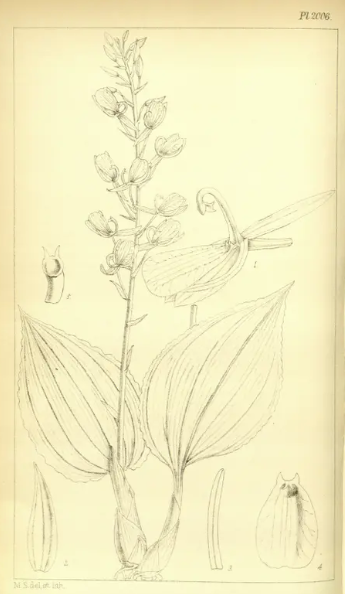 Below is another name described by someone: Liparis indrae (indraii – couldnt even give a correct spelling to species). You can see the barbate margin of the lip clearly here. 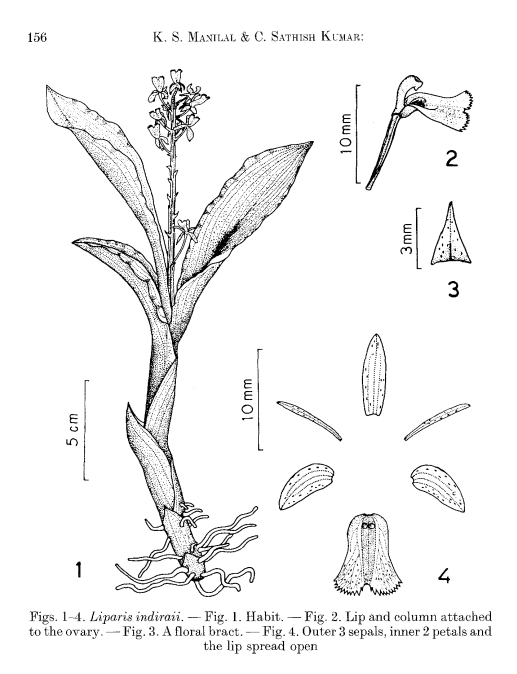 My conclusion is, Liparis barbata is kind of mixed up. Someone needs to sit down and separate things from there. .
It is my pleasure to share an image of fruiting in Liparis barbata (Orchidaceae) said to be extremely rare….! Was tempted to Re-visit this specimen that was identified as Liparis barbata in my earlier upload 12-8-2015_TSP_Orchid_Devaramane. It was still there, the flowers were gone but had developed fruit…! Habit: Herb Habitat: Wild, epiphytic in Evergreen forest. Sighting: Devaramane, Mudigere, Chikmagalur, Karnataka, about 1300 msl Date: 11-09-2015 Good one. Taking it as Liparis thwaitesii as per discussions at ANAUG12/12 Liparis sp. for identification .
Presenting few images of Liparis barbata (Orchidaceae )…..Leaves elliptic,apex acute,sessile,margin undulate,raceme terminal,presence of calli….! Habit:Herb Habitat:Wild,epiphytic,Evergreen forest Sighting:Devaramane,Chikmagalur,Karnataka,about 1300 msl Date:13-08-2016 Very very beautiful find, thanks for showing …!! No this is not barbata. Taking it as Liparis thwaitesii as per discussions at ANAUG12/12 Liparis sp. for identification
. References: 1997 IUCN Red List of Threatened Plants By Kerry Scott Walter, Harriet J. Gillett, World Conservation Monitoring Centre |
Liparis thwaitesii


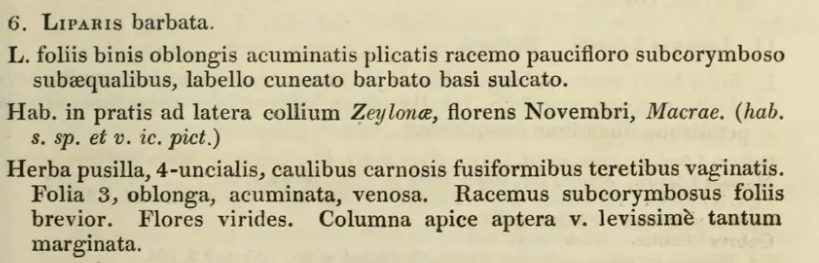
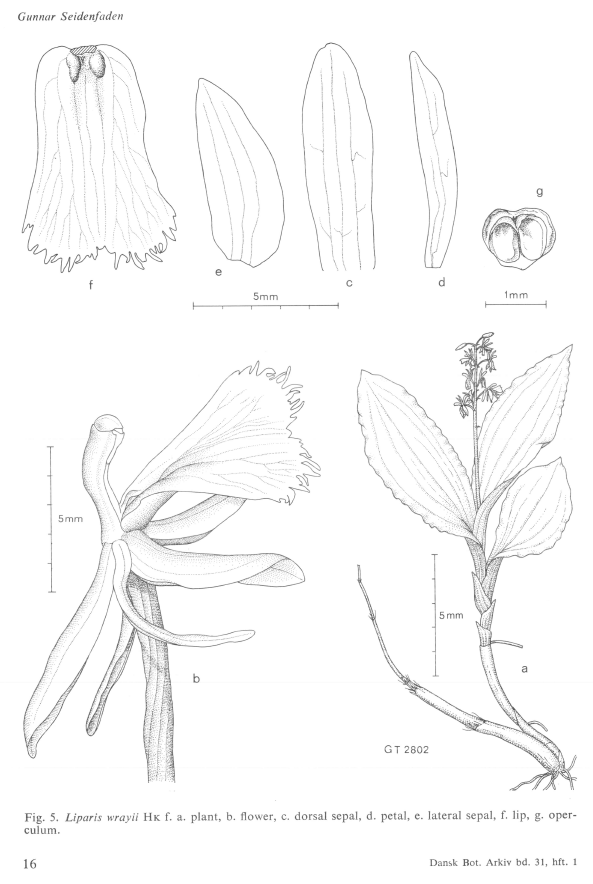


Updated on November 21, 2026