
|
Lonicera sempervirens L., Sp. Pl. 1: 173 173 1753. (Syn: Lonicera sempervirens var. sempervirens ; Periclymenum sempervirens (L.) Mill.; Phenianthus semperivens (L.) Raf. ex B.D. Jacks.);
.
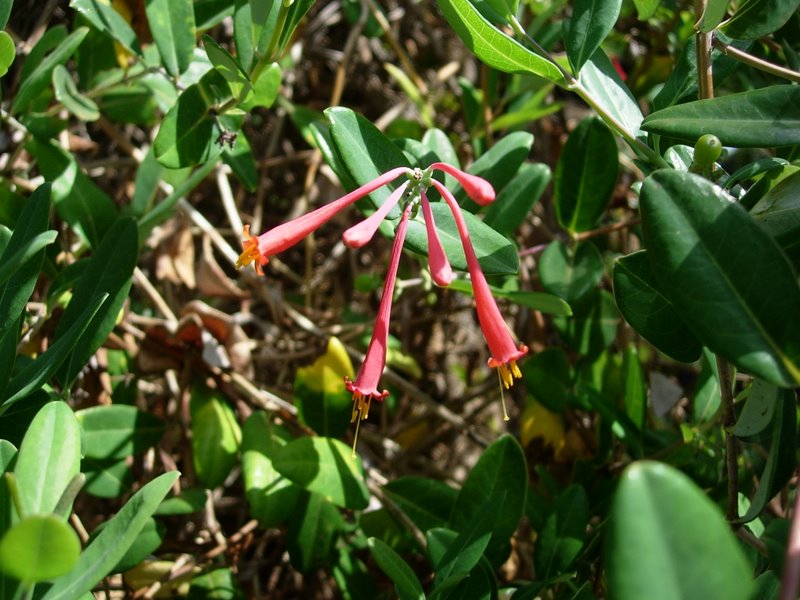
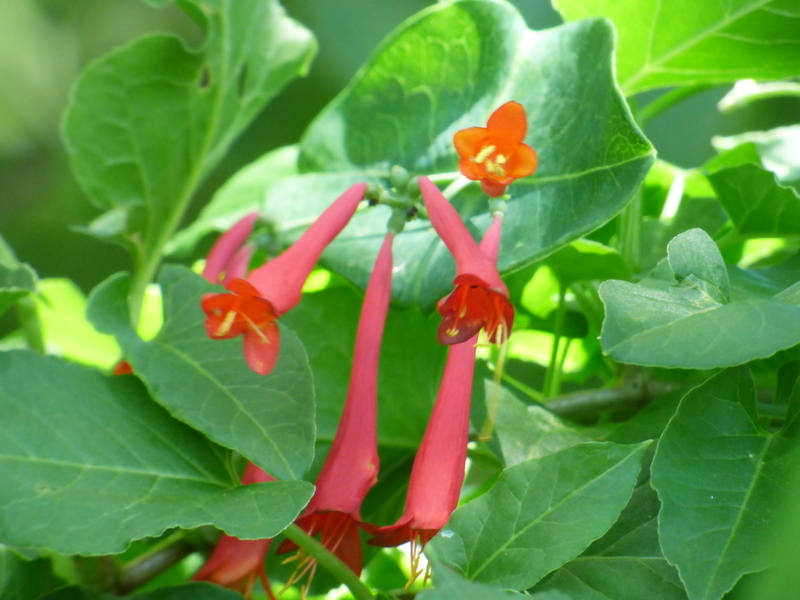
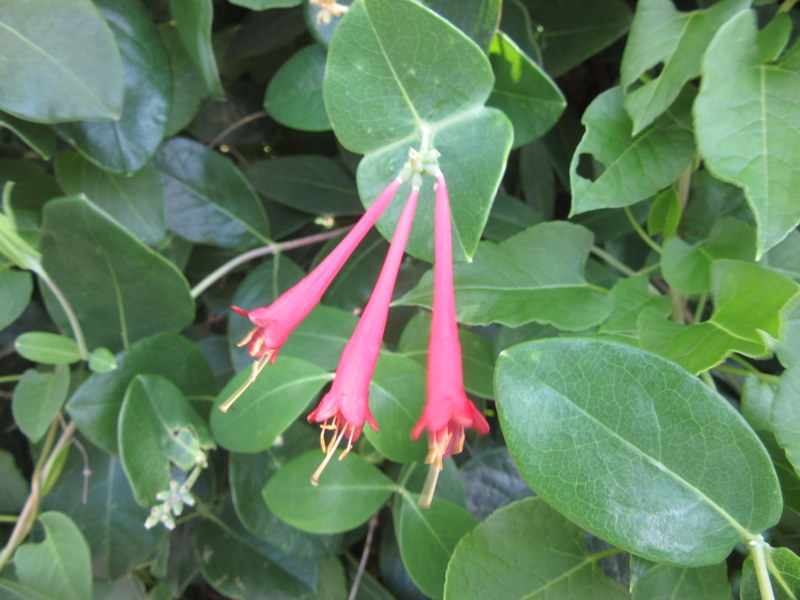
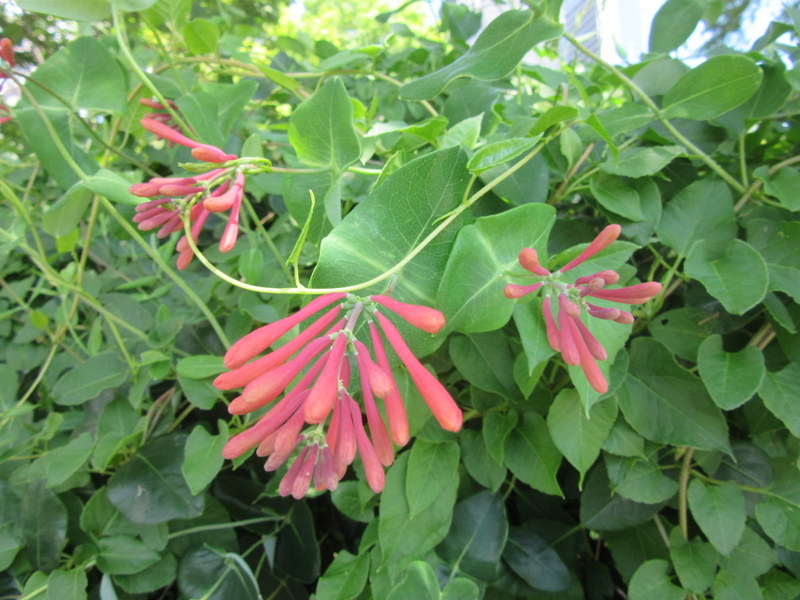
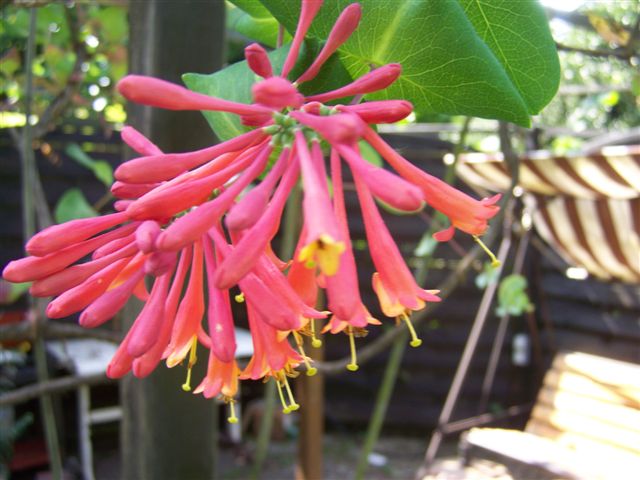
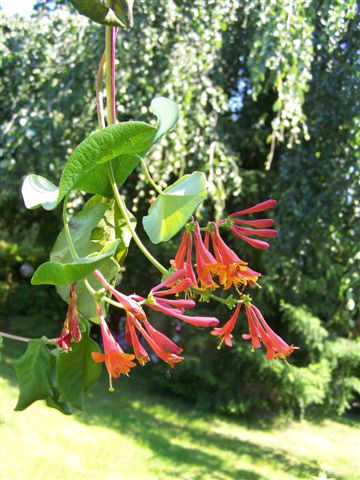
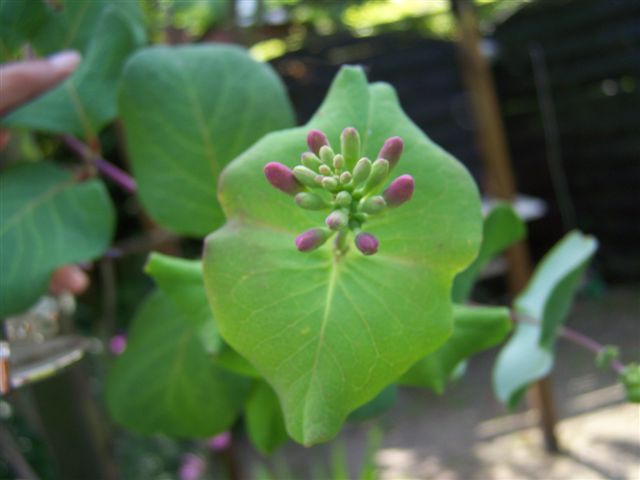
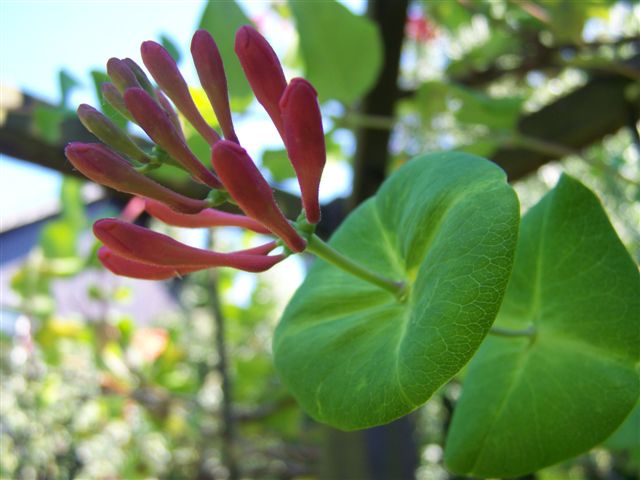
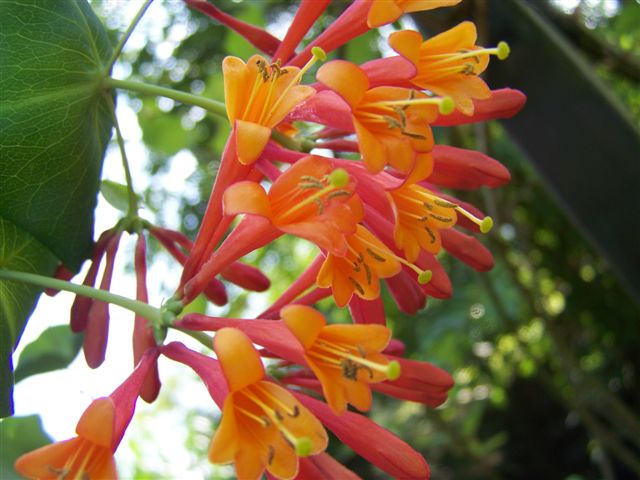
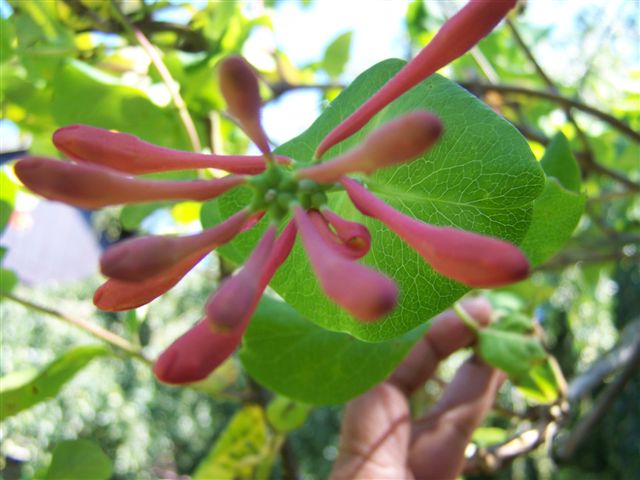
Lonicera sempervirens[a] (also coral honeysuckle or trumpet honeysuckle) is a species of honeysuckle native to the eastern United States.[2] It is grown as an plant for wildlife, as it is used by ruby-throated hummingbirds in their natural range.[3] It is also grown as an ornamental for its attractive flowers, especially as a native alternative to the invasive Japanese honeysuckle.[4][5] Several cultivars have been selected for variation in flower color, including ‘Magnifica’ (flowers red outside, yellow inside), ‘Sulphurea’ (yellow flowers), and ‘Superba’ (bright scarlet flowers).[6] The plant is evergreen in zone 8 and warmer and deciduous in colder climates. It is a twining vine growing to 20 ft or more through shrubs and young trees. The leaves are produced in opposite pairs, oval, up to 5 cm long and 4 cm broad; the leaves immediately below the flowers are perfoliate, joined at the base in a complete ring round the shoot. The flowers are produced in clusters of several groups of three together, tubular, 5 cm long, with five small lobes opening at the tip to expose the stamens and stigma; they are bright red to pinkish-red, and pollinated by ruby-throated hummingbirds and insects.[7][3] .
A scandent or evergreen climbing shrub. Stem semi woody. Young branchlets purplish grey. Leaves opposite, obovate to elliptic, or lanceolate, 5-7 x 3-5 cm across, shining, leathery, margin entire, apex acuminate, petiole 0.3-0.6 cm long, the uppermost pair of leaves are distinct, bases are fused together and slender stem passes in-between these two fused leaves, margin entire, apex is obtuse to truncate, to become perfoliate-connate, this condition is also seen when stem terminates a inflorescence anywhere between the base and shoot of the climber. Flowers axillary usually in whorled 3 pairs, peduncle 3-5 mm long, actinomorphic, Calyx glabrous, Corolla scarlet red in colour, Corolla tube 4-5 x 0.3 cm, glabrous, Stamens 5, slightly exserted, anthers bilobed, style glabrous, slightly exserted than the stamens and corolla tube. Fruits scarlet red about 0.4-0.7 cm in diameter, ellipsoid.
Flowering/Fruiting: June-October.
Cultivated in gardens.
Global Distribution: Asia: China; Europe; North America: Canada, Mexico, United States of America.
Local Distribution: Uttarakhand.
Attributions- Ganeshaiah, K. N., UAS, Bangalore, India. & Kailash, B. R., UAS & ATREE, Bangalore, India. from India Biodiversity Portal)
.
Creeper for ID : 240111 : AK-2: 4 posts by 3 authors. Attachments (1) Yes. Lonicera sempervirens, perhaps. I think … is correct Thanks for the id.
Lonicera sempervirens : For Validation : New York : 12AUG19 : AK-27 : 6 posts by 3 authors. Attachments (3) yes, coral honeysuckle .
These are the pictures of a climber from a garden near Rishikesh. Photographed during April 2017.
Please help to identify.
Lonicera sempervirens. Coral Honeysuckle
Yes from me as well. jelängerjelieber another lonicera sp. from Ritterhude : 5 posts by 3 authors. Attachments (6)
german name: jelängerjelieber from my garden in Ritterhude
I don’t think it is Lonicera periclymenum, the leaves are round.
I like shakespeare:
“What’s in a name? That which we call a rose
By any other name would smell as sweet.” Foto taken in August 2010
This is your Lonicera caprifolium Thank you …, I mixed up the fotos and the names. Thank you very much for correcting me.
Lonicera caprifolium indeed This appears closer to images of Lonicera sempervirens L. at
https://www.wildflower.org/gallery/result.php?id_image=13018 . References:
The Plant List Ver.1.1 Tropicos IPNI NPGS India Biodiversity Portal Wikipedia Dave’s Garden RHS Floriculture in India By Gurcharan Singh Randhawa, Amitabha Mukhopadhyay (1986)
|
Lonicera sempervirens (Cultivated)
Updated on November 24, 2025